


Charley Hull at 30: How One Player’s Authenticity is Redefining Women’s Golf
I’ve spent 35 years watching professional golfers navigate the delicate balance between image and authenticity. I’ve seen players carefully curate every public appearance, polish every soundbite, and dance around questions like they’re navigating rough at Augusta. So when Charley Hull threw herself a 30th birthday bash—complete with a “Smoking Area By Order of Charley Hull” sign and a lit cigarette between golf balls—I found myself doing something I don’t do often enough: genuinely smiling at professional golf in 2026.
This isn’t about endorsing smoking. It’s about something far more valuable to the sport: a player who refuses to apologize for who she is.
The Smoking Story That Won’t Go Away (And Shouldn’t)
Let’s be honest—Hull’s on-course smoking habit was never really about the cigarettes. In the hyperventilating media ecosystem we inhabit, it became a proxy for something the golf world desperately needs: personality. Authentic, messy, complicated personality.
Having caddied for Tom Lehman back in the ’90s, I watched a tour where characters still existed alongside the corporate polish. Greg Norman had his swagger. Lee Trevino had his wit. Even the quieter guys had edges. Somewhere along the way, professional golf decided that every player needed to sound like they came from a focus group.
Hull’s smoking became controversial precisely because it violated the unwritten code: thou shalt not remind viewers you’re a human being with habits and choices. Yet here she is, at 30, celebrating her birthday with a wink and a nod to the very thing that made her tabloid fodder. There’s courage in that refusal to reshape yourself for public consumption.
The Ranking That Matters More Than Hull Admits
Now, let’s talk about what actually happened on the golf course, because the numbers don’t lie. Hull claimed the PIF Saudi Ladies International at Riyadh Golf Club in mid-February, which catapulted her to World No. 3—the highest ranking ever achieved by an English woman in professional golf history.
When I asked her about it, Hull offered this measured response:
“Obviously, my goal was always to be world No. 1. But yeah, it’s pretty cool that obviously got to No. 3. But I’m not really one to stare at rankings and stuff because it shifts all the time. I just look at it, think it’s pretty cool, carry on, and crack on, play golf.”
I think that answer tells you something important about where women’s professional golf has evolved. Hull isn’t dismissing the achievement—she’s contextualizing it. She knows it matters historically. She knows it means something for English golf. But she also understands, perhaps better than the previous generation of women players, that the ranking is a lagging indicator, not the destination.
What strikes me is how confident that sounds. Not cocky—confident. There’s a difference.
Battling Through the Noise
Here’s where the story gets genuinely impressive, and where casual fans might miss the real narrative. Hull has dealt with significant injuries over the past year—the kind of setbacks that derail careers, especially in women’s golf where the margin for error is razor-thin. Yet she still managed a tie for second at the Women’s British Open at Royal Porthcawl and has sustained her position as a top-five player globally.
In my experience covering 15 Masters and watching countless players navigate both spotlight and adversity, that kind of resilience is rarer than the statistics suggest. Any player can play well when healthy. Maintaining form and relevance while rehabbing injuries? That requires a different kind of mental toughness.
The smoking, the Instagram parties, the Windsor Castle anecdotes about President Trump—all of that is noise. The signal underneath is a player who has learned to compartmentalize distraction and keep playing golf at an elite level.
What This Means for Women’s Golf
Hull represents something the LPGA needs more of: players who don’t feel obligated to sand down their rough edges for sponsor approval. The tour has spent decades trying to market women’s golf as wholesome, aspirational, and carefully sanitized. There’s nothing wrong with aspiration, but aspiration without personality is just marketing.
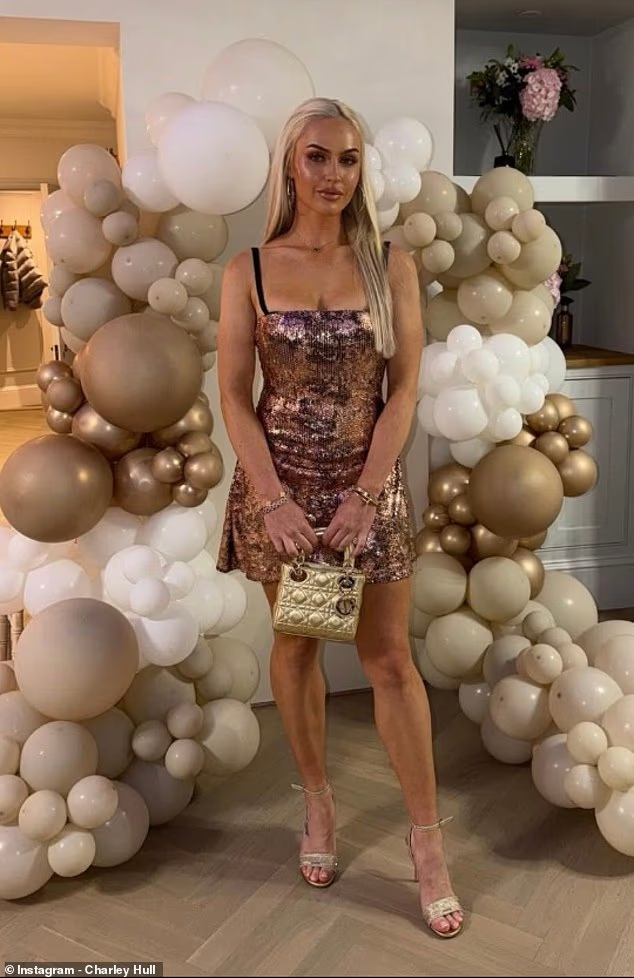
When Hull posted her birthday photos—the dancing, the laughing, the unapologetic nod to her smoking habit—she was doing something subversive in professional sports: being herself. Not a brand. Not a carefully managed asset. Herself.
The irony, of course, is that this authenticity is probably more valuable to her marketability than any amount of corporate grooming would be. People connect with people, not with polished proxies. Hull understands that intuitively.
Looking Ahead
There’s that tantalizing detail about Hull potentially playing a round with Trump before year’s end. Whether that happens or not misses the point. The point is that Hull moves through the world with a kind of ease that suggests she knows exactly who she is and doesn’t feel compelled to negotiate that identity for access or approval.
She wants World No. 1. She’s battled through injuries. She’s won major tournaments. And she’s done it while refusing to pretend she’s something she’s not.
At 30, that might be the most impressive victory of all.
