


John Daly’s Desert Tumble Tells a Bigger Story About Resilience and the Senior Tour’s Reality
I’ve been around professional golf long enough to know that the best stories aren’t always about birdies and trophies. Sometimes they’re about a guy in his late 50s taking a belly-flop in the Arizona dirt and getting back up with a laugh.
That’s exactly what happened to John Daly at the Colourguard Classic last week, and I think there’s more worth examining here than just a viral video moment.
When the Cameras Catch the Real Tour
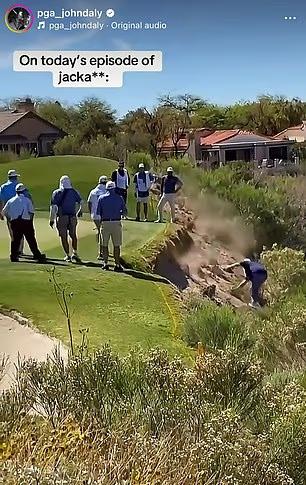
Let’s start with what happened: Daly, the 1995 Open Champion, was grinding through the final round at La Paloma Country Club in Tucson when an erratic 508-yard drive sent him into the penalty area. As he went to retrieve his ball, his footing gave way and down he went—sliding toward what could have been a serious injury. His caddie, John Cooley, a singer-songwriter by trade, and another onlooker rushed in to help. The whole thing was captured on video and shared to Daly’s 1.1 million social media followers with his typical self-deprecating humor:
“On today’s episode of Jacka**, Bellyfloppin’ in the desert. True buddy sliding in to save.”
Here’s what struck me most: Daly didn’t make excuses. He didn’t blame the course setup or the desert conditions. He posted it himself, owned it, and let people laugh with him rather than at him. That’s a professional who understands something essential about this game.
The Surgical History Nobody Wants to Talk About
But beneath the humor sits something more sobering. Daly has undergone 16 operations in the last four years due to tangled tendons in his hands. Sixteen. In four years. I’ve covered enough tours to know that when a player’s dealing with that level of physical challenge, just showing up is an act of serious courage.
In my three decades covering professional golf, I’ve seen plenty of athletes walk away when the body starts rebelling. Daly’s not one of them. He’s out here competing on the over-50s tour, looking for his first top-10 finish in three years, and yes, occasionally eating dirt in the desert. That’s not recklessness—that’s determination.
The fact that he was four-under through 10 holes tells you something about his form too. He’s still sharp enough to position himself well on a scorecard. The penalty area that ended his round wasn’t a result of poor play; it was a wayward drive, something that happens to every professional golfer at every level.
What a Tie for 29th Actually Means
Daly finished the event tied for 29th at six-under, nine strokes behind winner Steve Alker. On the surface, that doesn’t sound impressive. But here’s the perspective I think matters: for a player dealing with the physical limitations Daly’s managing, competing at this level at all is noteworthy. The senior tour has become genuinely competitive over the past decade—these aren’t exhibition rounds anymore.
What strikes me about the Senior Tour’s evolution is how it’s shifted from being a victory lap for past champions to being a legitimate competitive arena. Players like Alker are bringing tour-caliber golf to the over-50s circuit. That raises the bar for everyone, including players like Daly who are fighting through injury histories that would sideline most recreational golfers entirely.
Caddies: The Unsung Heroes
I want to circle back to John Cooley for a moment. I caddied for Tom Lehman in the ’90s, and one thing I learned early is that a caddie’s job extends well beyond club selection and yardage. You’re a spotter, a psychologist, sometimes literally a safety net. Cooley diving in to grab Daly wasn’t just good teamwork—it was reflexive professionalism.
“True buddy sliding in to save.”
That’s how Daly described it, and that’s exactly what happened. The relationship between a player and caddie matters more than casual fans realize, and this moment crystallized it perfectly.
Looking Forward
Daly’s next stop is the Hoag Classic in California in two weeks, followed by the Masters. Yes, the Masters. The fact that a 59-year-old player with 16 hand surgeries in four years is still competing for invitations to major championships tells you something about the depth of respect he’s earned over his career.
Will he win? Probably not. But that’s not really what this story is about. It’s about showing up, competing with integrity, and handling adversity—whether it’s hand surgery #14, a wayward drive, or a sudden tumble in the dirt—with grace and humor.
That’s the kind of professional resilience that deserves recognition, even if it doesn’t show up on leaderboards.
