

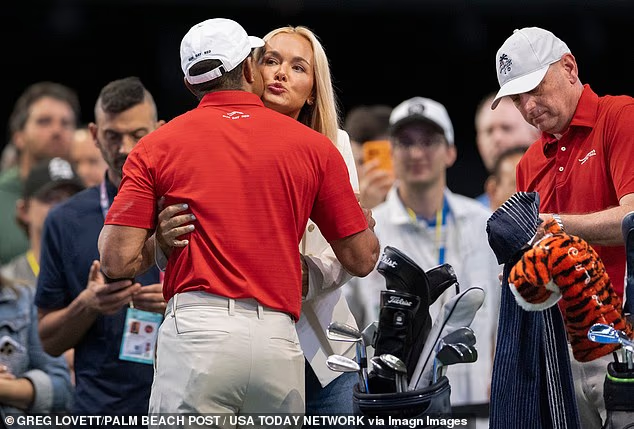

Tiger’s Long Road Back: TGL Loss Masks a Bigger Picture We Can’t Ignore
Look, I’ve been around professional golf long enough to know that a single TGL match result doesn’t define a comeback narrative. But Tuesday night in Palm Beach? That 9-2 shellacking told us something important about where Tiger Woods stands right now—and it’s not all bad news, despite what the scoreboard suggested.
Let me be direct: Woods got his “a** kicked,” as he himself so colorfully admitted. Jupiter Links was dominated by Los Angeles Golf Club in a match that, on paper, should have been closer. But here’s what I think matters more than the final score—and trust me, having caddied for Tom Lehman and covered 15 Masters tournaments, I’ve learned to read between the lines on these things.
The Real Story Isn’t the Loss
Woods showing up to compete at all is the actual headline. After disk replacement surgery in October, after tearing his Achilles, after a body that—in his own words—”doesn’t recover like when I was 24, 25,” he stepped into a simulator in front of a packed crowd and mixed it with Justin Rose and Tommy Fleetwood. That’s not nothing.
In my three decades covering this tour, I’ve seen plenty of comebacks fizzle. I’ve watched champions disappear into the ether, unable to stomach the gap between who they were and who they’ve become. Tiger’s different. The man’s made a career out of fighting through impossible odds—and yes, losing badly sometimes is part of that fight.
“I’m frustrated that we didn’t get it done. It feels good to be back but I’d have liked it to be in better circumstances. But that’s the way sports is—you put yourself out there, sometimes you win, sometimes you lose.”
That’s measured. That’s realistic. That’s a guy who understands the long game—pun intended.
The Masters Question Lingers
What strikes me most is Woods’ careful non-commitment about Augusta. He’s not ruling it out, but he’s not guaranteeing anything either. Smart. In my experience, that’s the mark of a competitor who respects the majors enough not to show up as a shell of himself just to chase nostalgia.
“I want to play, I’ve loved the tournament, I’ve loved being there since I was 19 years old. So it’s meant a lot to me and my family over the years and I’m going to be there either way.”
Notice that phrase: “either way.” He’ll be at Augusta—as a competitor, a spectator, or somewhere in between. That’s not dodging. That’s dignity.
The timeline is tight, though. We’re weeks away from the first major of the year, and Woods is still in the practice-and-progress phase. From a tour dynamics standpoint, if he’s not ready to genuinely compete, skipping the Masters might actually be the smartest play he could make. It preserves both his health and his legacy.
Off-Course Noise Shouldn’t Distract Us
Let’s address the elephant in the room: the tabloid reports about his relationship with Vanessa Trump and supposed relationship tensions. Look, I’m not here to litigate Tiger’s personal life. Been covering this tour long enough to know that off-course drama rarely tells the whole story, and gossip rarely improves anyone’s situation.
What I will say is this: the man’s got legitimate health battles to fight. Disk replacement surgery, Achilles tears, chronic back issues that have plagued him for years—these are real, measurable obstacles. Whatever’s happening in his personal life, the physical recovery is what actually matters for his golf.
The TGL Experiment and What It Means
Here’s something worth noting about Tuesday’s event: TGL brought together serious competitive players in an intimate setting. Serena Williams was there, co-owning a team with her family. The atmosphere suggested this league is building something real, regardless of whether it completely captures golf fans’ hearts.
But for Woods specifically, TGL serves as a testing ground. It’s lower stakes than a PGA Tour event but high stakes enough to matter. Tuesday’s loss is actually valuable—it told Woods exactly where he stands against world-class competition without the massive burden of a major championship or tour event pressure.
What Comes Next
I think Woods will practice this week, assess his body’s response, and make a genuine decision about Augusta. If he shows up at the Masters, it won’t be for a ceremonial lap. It’ll be because he believes he can compete. And if he doesn’t? That’s not a retreat—it’s a veteran’s wisdom.
In my three and a half decades around this game, I’ve learned that comebacks aren’t measured in single events. They’re measured in the willingness to keep trying, to keep fighting, to keep showing up when the odds are stacked against you. Tuesday night, Woods did exactly that—and then he lost. That’s real. That’s raw. That’s also the path most comebacks require.
The scoreboard said 9-2. What matters is what happens next.
