


Wyndham Clark and the Modern Golfer’s Media Minefield
Look, I’ve been around this tour long enough to know when a guy steps into quicksand on live television. Wyndham Clark did exactly that this week at The Players Championship, and what started as a lighthearted driver analogy somehow became a trending moment on social media for all the wrong reasons.
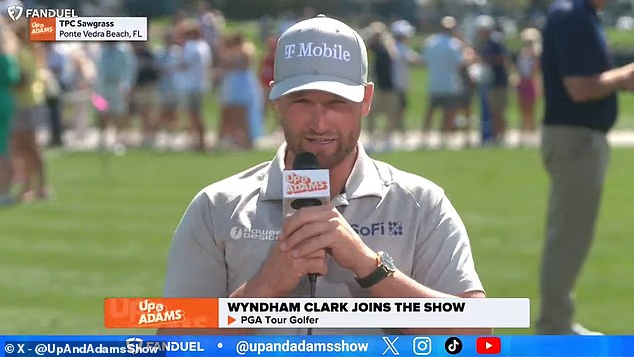
Here’s what happened: Kay Adams, conducting her Up & Adams show from TPC Sawgrass, asked the 2023 US Open champion about his frequent equipment changes. Clark, trying to be charming, pivoted the conversation with this gem:
“Sometimes it’s nice to have a week-long girlfriend, you know? I’m just kidding.”
Adams recovered gracefully, smiling through what was clearly an awkward moment. But the internet? The internet did what the internet does. Social media erupted with hot takes ranging from “Wyndham taking a shot here is wilddd” to comparisons of the interview to “Love Island at TPC Sawgrass.”
The Generational Shift in Tour Culture
In my 35 years covering professional golf—and yes, that includes caddying for Tom Lehman back when you could say things without them being screenshot and dissected by 200,000 strangers—I’ve watched the relationship between players and media evolve dramatically.
What strikes me most about this moment isn’t that Clark made a flippant comment. It’s that he made it so casually, as if the old rules about player-media interactions no longer apply. And honestly? They might not.
The modern golfer exists in this strange dual reality. On one hand, players are more accessible than ever—social media, streaming shows, constant content creation. On the other hand, that accessibility has made every word infinitely more scrutinizable. There’s no off-camera anymore. There’s no throwaway line that stays in the clubhouse.
Clark, at 33 years old and a legitimate tour star, seems to operate under the assumption that banter with a sports broadcaster works the same way it does with his fellow competitors. Maybe it does in private. But on a show being recorded and immediately distributed to millions? Different ballgame entirely.
Equipment Analogies and the Line Between Clever and Clumsy
Here’s where I have to give Clark some credit, though: the driver analogy actually works. The guy’s changed equipment four times already in 2026. That’s legitimately worth talking about.
“I’m a free agent and sometimes it’s nice to spice things up [and switch drivers]. The honeymoon stage can be really nice.”
See? That’s good insight into modern tour strategy. Equipment sponsorships are looser now than they used to be. Players have real agency in what they’re using, and that freedom has changed how guys approach their arsenals. Clark’s currently locked in with TaylorMade after switching drivers multiple times this season—a perfectly legitimate talking point.
The problem was grafting romantic relationship humor onto what should have been straightforward equipment discussion. It felt like Clark was trying to be the guy at the party who’s always got a joke lined up, except he forgot he was at the professional sports equivalent of a company town hall meeting.
What the Social Media Reaction Actually Reveals
One Twitter user called it a “painful watch.” Another asked, “Do you enjoy being objectified by these man-babies?” This criticism matters because it reflects a genuine frustration many viewers feel when athletes use flirtation as their default conversational currency.
In my experience, the best player-broadcaster interactions happen when both parties treat each other as professionals first. Kay Adams is a legitimate sports journalist doing her job. The moment Clark pivoted away from actual content toward personal-life innuendo, he created an uncomfortable dynamic—even if it was meant as humor.
What’s interesting is that Adams handled it perfectly. She didn’t shame him, didn’t storm off, didn’t make him the villain. She smiled, she played along, and she moved the conversation forward. That’s professionalism under pressure. But the fact that she had to recover at all is the real story here.
The Bigger Picture for Tour Culture
The PGA Tour has spent the last few years desperately trying to modernize its image, appeal to younger audiences, and make golf feel less stuffy. Players are encouraged to be personality-driven, to engage with media, to be “authentic.” That’s not inherently bad. But there’s a difference between being personable and being inappropriate.
Clark’s comment wasn’t egregiously offensive. It wasn’t harassment. It was just… tone-deaf. The kind of thing that reads one way in a clubhouse conversation and completely different when broadcast to the world.
What I hope happens next is simple: Clark learns from this moment, and other players learn from watching it unfold. The tour’s success in attracting younger viewers and sponsors depends on these interactions feeling natural but professional. A player can be funny, charismatic, and real without defaulting to romantic subtext.
As for Clark himself? He’s too talented, too accomplished, and frankly too smart to let one awkward media moment define anything. The guy won a major championship. He’s a legitimate tour star. One weird interview isn’t career-defining. But it’s also a reminder that in 2026, everything lives forever on the internet, and the line between “relatable and funny” versus “uncomfortable” is thinner than it’s ever been.
He’ll be fine. Kay Adams was fine. The tour will move on. But the digital footprint? That stays.
