


When the Game Stops: What Brooks Koepka’s Cart Incident Tells Us About Golf’s Evolving Responsibilities
I’ve been walking these fairways for thirty-five years now. I’ve seen weather delays, rules controversies, medical emergencies, and every crisis imaginable unfold on professional tour grounds. But Saturday’s incident at Copperhead during the Valspar Championship—a young girl trapped beneath a golf cart in front of thousands of spectators—reminded me of something we don’t talk about enough: professional golf exists within a delicate ecosystem where player, fan, and safety intersect in ways that extend far beyond the scorecard.
What happened was preventable. What happened next, though, tells us something encouraging about where the game is heading.
The Moment Everything Stops
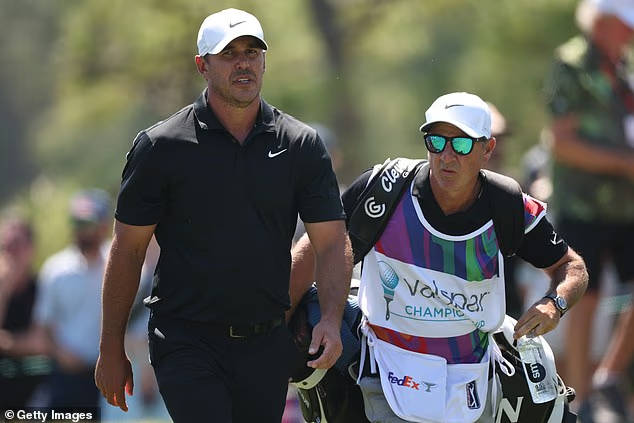
According to tournament officials, the girl was struck by a slow-moving fan cart and became trapped beneath it while Brooks Koepka and Danny Walker were playing the 15th hole. Play halted immediately. Medical personnel responded. Five minutes later, a young fan was freed, checked out by medical staff, and—mercifully—walked away without serious injury.
“After a few anxious moments, it was determined that she had not sustained any serious injuries. After her mother apologized, she left on her own with her family, and to our knowledge did not require any further medical assistance beyond that she quickly received on the scene.”
That’s the statement from tournament officials, and I’ll admit: reading those words brought real relief. In my decades around professional golf, I’ve seen enough close calls to know how quickly “scary moment” becomes “tragedy.” The outcome here could have been catastrophically different.
What interests me more than the incident itself, though, is what happened in its immediate aftermath—and what it reveals about modern professional athletes’ evolving role beyond their sport.
Character in the Moment
Koepka, tied for 16th at three-under after shooting 71 that day, did something that I’ve seen less frequently than you might expect from Tour professionals in high-pressure situations: he stopped thinking about his golf game.
According to reports from Golf Channel, Koepka stepped off the fairway specifically to check on the girl and comfort her. Danny Walker did similarly commendable work in helping summon assistance. These weren’t players who nodded at the scene before retreating to their mental space. They engaged. They helped.
“She’s OK, thankfully, so that’s all that matters. I know she’s probably a little scared, and I just felt for her at the time. It’s unfortunate, it shouldn’t have happened. But as long as she’s OK—and nothing crazy happened to her—then it will be OK.”
I’ve caddied for competitive golfers. I know the mental fortress these guys build during tournament play. The ability to compartmentalize, to wall off distractions, to stay locked into the next shot—that’s not weakness; that’s professional discipline. Which is exactly why Koepka’s choice to break that focus and engage with a frightened child struck me as noteworthy. In my experience, that requires genuine character.
Tournament officials recognized it too, praising both players for doing a “commendable job” in the immediate response.
The Broader Questions
Here’s what I think matters beyond the heartwarming moment: this incident exposes real vulnerabilities in how golf manages fan safety during tournament play. A slow-moving vehicle shouldn’t trap anyone. Period. Full stop.
In fifteen Masters Tournaments alone, I’ve watched how course management, spectator flow, and vehicle operations have evolved—and they continue to evolve. Augusta National, for all its traditions, takes safety obsessively seriously. Not every tour stop has that infrastructure. The Valspar Championship, held at Copperhead Course in Tampa, draws substantial crowds but operates with different constraints than the majors.
The question isn’t whether Koepka and Walker handled the moment with grace—they clearly did. The question is whether the PGA Tour and individual tournaments are aggressively examining how we prevent these moments from occurring in the first place. Cart operations, spectator barriers, course marshaling protocols—these deserve serious institutional attention, not just individual heroism to clean up afterward.
Looking Forward
What strikes me most about this incident is that it happened and—critically—that the girl is fine. That outcome required luck and quick medical response, but it also benefited from professionals who understood their platform extends beyond tournament standing.
Professional golf has spent the last decade navigating significant change: LIV Golf’s emergence, equipment evolution, pace-of-play reforms, and demographic shifts in fandom. In the midst of all that structural noise, we sometimes forget that the game still lives in human moments—moments when a five-time major champion chooses compassion over scorecard obsession.
The Valspar Championship continued. Sungjae Im held a two-stroke lead over Brandt Snedeker and David Lipsky heading into Sunday’s final round. Koepka remained in contention. Life on tour went on.
But those five minutes when play stopped at the 15th hole? That’s the golf story that actually matters this week—not because it’s dramatic, but because it reveals character. And in a game built on honor codes and integrity, that’s always worth remembering.
