


Anthony Kim’s Comeback Teaches Us Golf’s Most Humbling Lesson
I’ve been covering professional golf for 35 years now, and I’ve seen plenty of comebacks—some triumphant, some tragic, and most somewhere in between. But Anthony Kim’s resurging form at the tail end of 2025 has me thinking about something I should’ve written about years ago: sometimes the answer to our biggest problems is hiding in plain sight, right under our noses. Literally.
When Kim announced his return to competitive golf two years ago after a 12-year hiatus, the narrative practically wrote itself. Here was golf’s folk hero from the 2000s, the electrifying young talent who had captivated galleries and seemed destined for major championships. The comeback story was irresistible. Golf media, myself included, had visions of Kim reclaiming his place among golf’s elite.
What we got instead was painful to watch. Two years of struggle, missed cuts, and finishes so forgettable they barely registered on the scoreboard. I’ll be honest—after covering the tour for this long, I wondered if Kim was chasing a ghost, trying to recapture something that simply couldn’t be recaptured.
The Setup Problem Nobody Wanted to Talk About
Then came November 2025, and suddenly something shifted. Kim’s game came alive. A tied-fifth finish at the Saudi International. A third-place showing at the LIV Promotions event. And finally, a victory at LIV Golf Adelaide—his first win since the 2010 Shell Houston Open.
What changed? The answer, I have to admit, is both fascinating and frustrating in its simplicity.
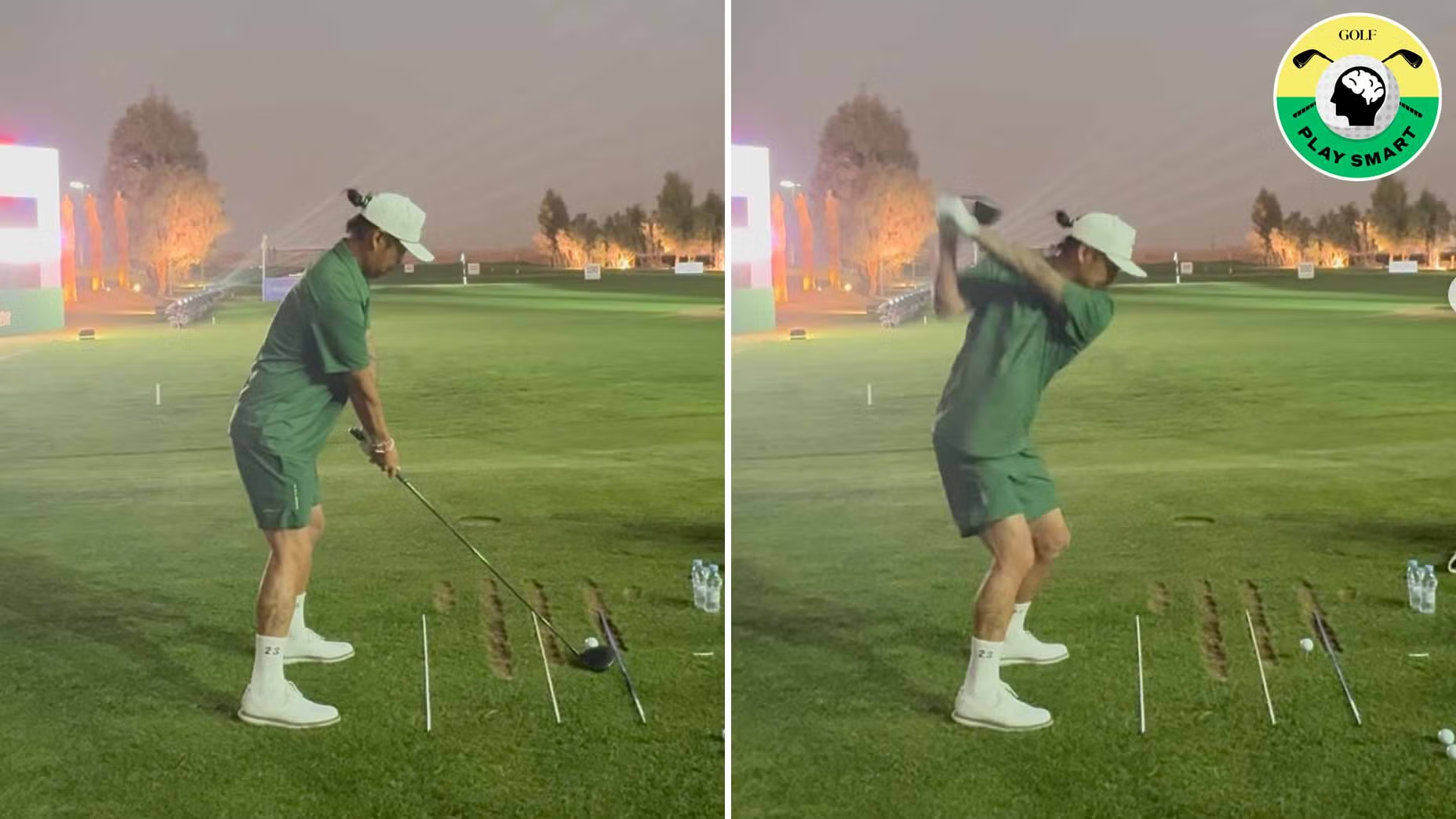
“I’ve been working on my setup the last two years,” Kim said. “I just didn’t know where I was aimed … Since I’ve been back playing golf, my feet have been right — my shoulders have been right; my feet have been further right.”
Let me translate that for you: Kim was aiming at the wrong targets. Not missing them intentionally. Not struggling with swing mechanics. He was literally standing over the ball and pointing himself in the wrong direction.
In my three decades around this game—including my years as Tom Lehman’s caddie—I’ve learned that alignment is the foundation upon which everything else in golf is built. You can have the most beautiful swing in the world, but if you’re aimed at the wrong target, you’re fighting a losing battle from the moment you address the ball. What strikes me most about Kim’s situation is that this fundamental issue went undiagnosed for two full years.
Kim revealed he’d been working with GOLF Top 100 Teacher Matt Killen, but here’s the key detail that most people glossed over:
“Really not working too much on my golf swing, just working on my setup,” Kim said. “If I can get that squared away, I know I can hit a lot of good shots.”
This is what separates a good teacher from a great one—knowing when NOT to overhaul the swing. Killen didn’t try to rebuild Kim from the ground up. Instead, he went back to brass tacks, to the ABCs of golf instruction. Fix what’s broken at address, and everything else has a chance to fall into place.
Why This Matters Beyond Kim
Here’s what’s been rattling around in my head since Kim won in Adelaide: How many recreational golfers are struggling with the exact same problem right now, and how many of them will never figure it out?
I’ve watched thousands of amateur golfers over the years, and I’d wager a significant portion are fighting alignment issues without even knowing it. They’ll spend money on new equipment, take expensive lessons focused on swing mechanics, and wonder why their golf isn’t improving. All the while, they’re standing over the ball aimed at the wrong target.
The golf industry—and I say this with some affection for the business that’s employed me for most of my adult life—isn’t always incentivized to diagnose simple problems. There’s more money in swing analysis software and equipment upgrades than there is in spending 20 minutes checking somebody’s alignment with a couple of alignment sticks.
What strikes me most about Kim’s comeback is its validation of a principle I’ve seen work countless times: the fundamentals matter more than we want to admit. In an era where golf instruction has become increasingly technical, where we obsess over club head speed and angle of attack, Kim’s story is a reminder that sometimes you need to grab an alignment stick and check the basics.
The Silver Lining in Years of Struggle
I don’t want to minimize the difficulty of Kim’s two-year struggle. Watching a talented player spin his wheels is painful. But I also think there’s something valuable in what happened here—even if it came at a considerable cost.
Kim’s victory at Adelaide didn’t just give him a win. It gave him confidence that his game could still compete at the highest level. It proved that the years away, while costly, didn’t permanently damage his abilities. And perhaps most importantly, it validated the work he’s done on the fundamentals.
For every golfer watching Kim’s resurgence, there’s a lesson: when your game falls apart, don’t immediately assume you need a complete overhaul. Check your setup. Check your alignment. Check whether you’re actually aiming at your target. Sometimes the answer to our biggest problems really is that simple.
After 35 years covering this game, I’ve learned that golf has a way of humbling us with its simplicity. Anthony Kim’s comeback is the latest reminder.
