


Rory’s Masters Dinner Reveals the Heart Behind the Champion
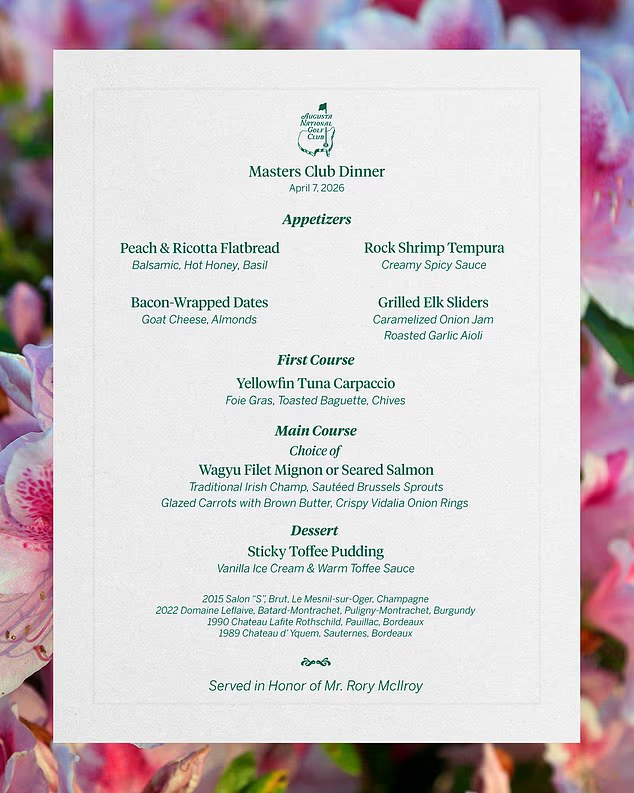
I’ve covered 15 Masters Tournaments, and if there’s one thing I’ve learned in 35 years around professional golf, it’s that you can tell more about a man by what he serves at his Champions Dinner than you can from his scorecard. So when Rory McIlroy sat down this week to unveil his menu for the 2026 edition—his first as a Masters champion—I found myself reading between the lines of elk sliders and sticky toffee pudding.
What I saw was a guy who, after finally capturing that fourth major to complete the career Grand Slam, chose to honor where he came from rather than where he’s arrived.
The Champions Dinner: More Than Just Dinner
For those who don’t know the tradition, the Masters Champions Dinner dates back to 1952 and represents one of golf’s most exclusive gatherings. The previous year’s winner gets to curate the entire menu—appetizers through dessert, right down to the wine list—for a room full of every living Masters champion. It’s part celebration, part responsibility, and honestly, it’s become a window into who these guys really are.
Scottie Scheffler went full Texan last year with his five-alarm chili and wood-fired cowboy ribeye. The reactions were predictably split—some called it genius, others thought it was a bit much. But that’s the beauty of this tradition: there’s no wrong answer, only authentic choices.
McIlroy’s selections tell a different story than Scheffler’s, and I think that’s exactly the point.
Northern Irish Pride Meets Augusta Tradition
Let me break down what struck me most about Rory’s menu. First, look at what he led with:
“When I was a kid, I used to eat champ by the bowl full. So I’m trying to tie in a little bit of my upbringing.”
That’s not a guy showboating. That’s a guy saying, “I belong here, and I’m not forgetting who I am.” Irish champ—mashed potatoes with scallions, milk, and butter—is about as humble as it gets. There’s no molecular gastronomy there, no foam, no theatrical presentation. It’s comfort food from his childhood, which he’s now serving in the most exclusive dining room in golf.
Having caddied in the ’90s and worked those Augusta grounds more times than I can count, I’ve seen champions approach this dinner two ways: either they use it to impress everyone with how fancy they’ve become, or they use it to remind themselves—and everyone else—of their roots. Rory chose the latter, and I respect that immensely.
He balanced those personal touches with sophistication, though. The grilled elk sliders came from prep work leading into his 2025 victory—
“In the build up to the Masters last year, I was eating a lot of elk. I got this big shipment of elk, and I was eating a lot of that. But I didn’t want elk to be the main course, because I didn’t know if everyone would like that, so I incorporated it into the appetizers.”
That’s strategic thinking. He’s saying, “This worked for me, but I’m not forcing it on everyone.” Compare that to some past menus I’ve covered where winners made choices that felt more about one-upping the guy from the year before.
The Details That Matter
What really impressed me, though, was how McIlroy wove in local Augusta flavors alongside his Northern Irish heritage. Georgia peaches on the flatbread, crispy Vidalia onion rings (Vidalia’s about two hours south of Augusta—he did his homework)—these aren’t accident. These are the choices of someone who respects both where he comes from and where his greatest achievement took place.
Then there’s the Yellowfin tuna carpaccio with foie gras, inspired by Le Bernardin, the three-Michelin star restaurant in Manhattan that he and his wife Erica love. But here’s where you see real class: Augusta National’s chefs actually worked with Le Bernardin’s staff to get the recipe right. That collaboration between one of America’s most exclusive golf clubs and one of the world’s finest restaurants? That’s the kind of detail that separates a great menu from a good one.
For wine, he brought in his good friend Shane Lowry to help select—including a 1990 Bordeaux that runs $1,300 a bottle.
“My favorite part of the menu is you get access to the wonderful wine cellar at Augusta National.”
Again, notice what he’s celebrating: not his own wealth or status, but the privilege of the place and the opportunity to experience something exceptional.
The Divide—And Why It Matters
Predictably, social media split on the menu. “These menus are always horrific,” one user wrote, while another said simply, “Standing ovation. That’s an elite menu.”
In my experience, people who’ve been around championship golf understand why these menus matter beyond just the food. They’re autobiographical. They’re a champion saying, “This is what made me who I am.” Rory’s menu says he’s someone who remembers his mother’s bacon-wrapped dates, who still loves his mother Rosie enough to credit her specifically, who eats elk when he’s preparing for the biggest moment of his career, and who knows that sticky toffee pudding with vanilla ice cream is a dessert that brings people together.
That’s not a guy who forgot where he came from. That’s a guy who finally reached the mountaintop and had the good sense to remember the path.
The Champions Dinner tradition at Augusta has evolved over 70 years into something genuinely special—part celebration, part character study. Rory’s 2026 menu won’t be the flashiest we’ve ever seen, but I’d argue it’s one of the most thoughtful. And if there’s one thing I’ve learned in three and a half decades covering this tour, it’s that thoughtfulness usually reflects championship caliber in more ways than one.
