


The Cruel Beauty of Pebble Beach: Why Min Woo Lee’s Loss Might Be His Greatest Teacher
I’ve been covering professional golf for thirty-five years, and I’ve watched enough tournaments end in heartbreak to fill a small library. But something about Colin Morikawa’s victory over Min Woo Lee at Pebble Beach this week struck me differently. It’s not just about the $2 million swing in prize money—though that sting is real. It’s about what this loss reveals about the mental architecture required to win at the highest level of professional golf.
Let me be clear: Min Woo Lee played beautifully. The young Australian seized control down the stretch, birdying both 17 and 18 to post what he believed would be a winning total. In most weeks, in most conditions, that sequence ends with a trophy presentation and Lee collecting his $5 million first-place check. Instead, he’ll pocket just over $3 million for second place—a payday most golfers would dream about, but one that tastes like defeat when you were holding the trophy moments earlier.
The Shot That Changed Everything
Here’s what fascinated me most about Morikawa’s approach on the 18th: the shot itself was unconventional bordering on reckless. He aimed left of the green into vicious crosswind conditions, seemingly accepting that his ball would travel offline. Then came the magic—the wind brought it back, depositing his ball in a makeable position for birdie.
“He smashed his iron well left and over the water, which then allowed the wind to bring the ball back over the green and land next to the putting surface.”
Now, I’ve caddied before. I carried Tom Lehman’s bag through enough PGA Tour events in the ’90s to know the difference between skill and fortune, and here’s what I think: Morikawa understood something Lee didn’t in that moment. When you’re down a shot on Pebble Beach’s brutal 18th hole, you don’t play safe. You play aggressive. You accept the possibility of failure to create the opportunity for success.
The irony, of course, is that Morikawa’s “reckless” approach worked. But that’s not luck talking—that’s experience. This is Morikawa’s seventh PGA Tour victory, and you don’t accumulate that kind of résumé by being timid down the stretch.
What the Scoreboard Doesn’t Show
In my three decades covering the tour, I’ve learned that prize money totals and final margins tell only half the story. What matters more is how a player processes defeat at that level, especially when victory was within reach.
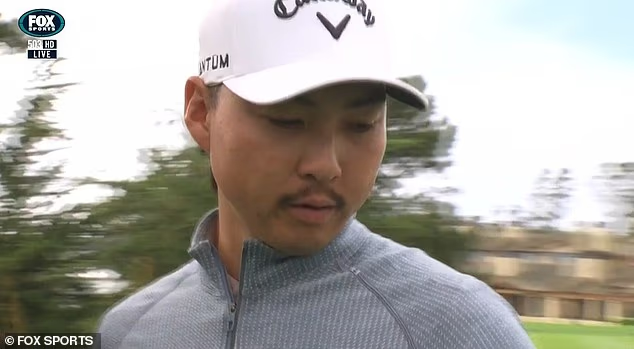
“Vision of Lee’s reaction to the unprecedented shot was caught on cameras. The Aussie was impressed but equally deflated given the stroke essentially set Morikawa up to steal victory.”
That reaction—the mix of respect and devastation—is instructive. Lee isn’t some rookie learning his first hard lesson. He’s an accomplished player who should have plenty more opportunities at Pebble Beach and beyond. The question is whether he uses this as motivation or allows it to become a scar.
What strikes me is that Lee didn’t lose because he played poorly down the stretch. He lost because Morikawa played better when it mattered most. That’s a subtle but crucial distinction. One narrative leads to self-doubt; the other leads to respect for an opponent’s skill and a determination to match it next time.
The Silver Lining (Yes, There Is One)
Here’s where I want to push back against the melodrama in the headlines. Yes, Lee left millions on the table. Yes, watching Morikawa celebrate while you’re collecting a runner-up check stings in ways that money can’t quite soothe.
But $3 million is not a failure. $3 million for finishing second in a PGA Tour event is a validation that Lee belongs in this conversation, that he can compete with the best players in the world, that he came agonizingly close to victory. In my experience, that’s worth more than the raw number suggests.
The modern tour landscape is brutal in how it rewards excellence. Lee’s second-place finish might generate headlines like he came up short, but the financial reality tells a different story: the tour recognizes his performance as elite. That matters.
Looking Forward
What I’m watching now is whether this loss becomes a launching pad or a stumbling block. For most players at Lee’s level, it’s the former. They absorb the lesson, they replay the back nine, they come back hungrier. And if history is any guide, Lee strikes me as someone with that mentality.
Morikawa, for his part, showed exactly why he’s among the tour’s elite. His willingness to attack on 18, his ability to execute under pressure, his composure embracing his partner after the birdie—these are the hallmarks of a player who knows how to close tournaments when it matters.
As for Lee? He should take solace in this: Pebble Beach will host many more tournaments in his career. And next time, when he’s standing on the 18th tee with a chance to win, he’ll remember this day. He’ll remember how close he came. And that memory, more than any prize money, might be exactly what he needs to finish the job.
Sometimes the best education happens when the scoreboard says you’ve lost.
