


Northern Ireland’s Golf Renaissance: Why This Summer Might Be Golf Tourism’s Sweet Spot
After 35 years covering professional golf, I’ve learned that major championships don’t just happen in isolation—they create ripples that reshape entire regions for years afterward. The 2025 Open Championship at Royal Portrush isn’t just another week on the calendar. It’s a moment that’s fundamentally repositioning Northern Ireland as a golf destination in ways I haven’t seen since the Open returned to links land after decades away.
What strikes me most about the current moment is the convergence of timing. We’re looking at a region that just hosted one of sport’s most prestigious events, maintained world-class infrastructure, and now has legitimate momentum to capitalize on it. That’s not always how these things play out. Sometimes a major comes, the cameras leave, and the opportunity slips away. But Northern Ireland’s golf community seems determined to make this different.
The Post-Major Boost Nobody’s Talking About
Here’s what most golf media missed: the real story isn’t the championship itself. It’s what comes after. Having caddied for Tom Lehman back in the ’90s, I watched how venues leveraged major championships into sustained tourism revenue. Northern Ireland’s doing this smartly.
“Named as one of the top-100 golf courses in the world, this is one of the most impressive rounds of golf you’ll ever play.”
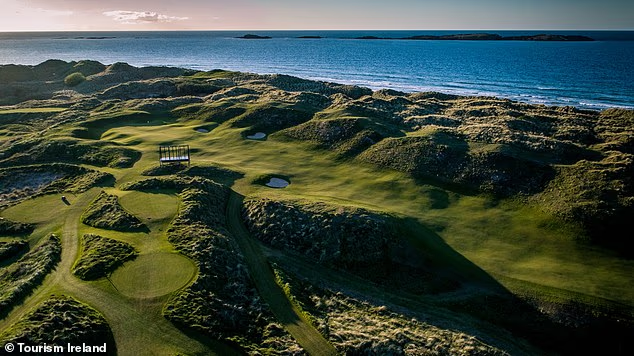
That description of Portstewart Golf Club isn’t hyperbole—it’s legitimate world-ranking territory. And here’s the insider perspective: courses like Portstewart, Royal Belfast, and Castlerock weren’t suddenly great because the Open came to town. They’ve been exceptional for decades. The championship simply shined a spotlight on what locals already knew.
In my experience, the courses that suffer post-major letdowns are the ones that oversold their difficulty or failed to deliver on mystique. Northern Ireland’s tracks are the opposite. They’re genuinely difficult, genuinely beautiful, and genuinely worth a pilgrimage.
The Infrastructure Play That Actually Works
What separates a successful post-major tourism push from a forgotten one often comes down to accommodation and logistics. The itinerary outlined here—Culloden Estate and Spa in Belfast, Dunluce Lodge in Portrush—shows sophisticated thinking about the golfer’s journey.
“The Dunluce Lodge is also where McIlroy chose to stay during the 2025 Open Championship.”
That’s the kind of detail that matters more than people realize. When Rory McIlroy stays somewhere, it becomes part of the narrative. It’s not marketing—it’s authenticity. I’ve seen golf tourism surge or stagnate based entirely on whether the lodging met expectations. A state-of-the-art spa after a brutal day on a Northern Ireland links? That’s not luxury—that’s recovery strategy.
The proximity advantage is equally important. A ten-minute drive from the Culloden to Holywood Golf Club, another ten minutes to Royal Belfast—this isn’t random. It’s course architecture for the region itself. The travel distances are humane, the courses are world-class, and the cultural experiences (Titanic Belfast, Giant’s Causeway, Bushmills Distillery) add depth beyond golf.
What This Says About Golf Tourism’s Future
Here’s my take, and I think it matters: golf tourism is increasingly about experiences, not just scorecard bragging rights. The days of purely golf-focused trips are fading. Modern golfers—especially those wealthy enough to book international travel—want context. They want stories. They want to understand *why* a place matters.
“Golf is more than a sport in these parts of Northern Ireland. It is intrinsic to the culture and heritage of this part of the world.”
That statement nails something crucial. Portrush isn’t trying to be Augusta National with ocean views. It’s authentically itself—a seaside town where golf has been woven into the cultural fabric for 150 years. The Harbour Bar, where Shane Lowry famously toasted his 2019 Open victory with the Claret Jug? That’s not a tourist attraction bolted onto the golf experience. That’s golf *being* the cultural experience.
The Courses Worth Actually Playing
If you’re planning a Northern Ireland golf trip, here’s what the itinerary suggests as your absolute must-plays:
- Holywood Golf Club – Rory McIlroy’s home course, featuring the Rory McIlroy Experience museum with his major championship trophies
- Royal Belfast Golf Club – Founded 1881, designed by Harry Colt, offering Belfast Lough views and the challenging par-3 11th
- Castlerock Golf Club – A hidden gem that’s hosted the Irish PGA Championship four times, featuring tall banks and fast greens
- Portstewart Golf Club – Consistently ranked in the world’s top 100, with what many consider the world’s best front nine
- Royal Portrush – The 2025 Open Championship venue, home to the infamous “Calamity Corner” 16th hole
Beyond these, Royal County Down—ranked third in the world by Top 100 Golf Courses with views of the Mourne Mountains—and Lough Erne are legitimately worth the travel.
Timing Your Visit
The article mentions summer 2026 as an ideal booking window, and I’d agree with that timing for practical reasons. Post-Open euphoria will have settled into sustainable tourism, the infrastructure investments will be fully operational, and courses will have optimized their booking systems without the championship-week chaos.
What Northern Ireland has accomplished here is subtle but significant. It’s built a golf destination framework that serves everyone from serious links golfers chasing world rankings to casual players looking for a memorable week away. That balance—between preserving authenticity and embracing tourism—is harder than it looks. Based on what I’m seeing, they’ve gotten it right.
