

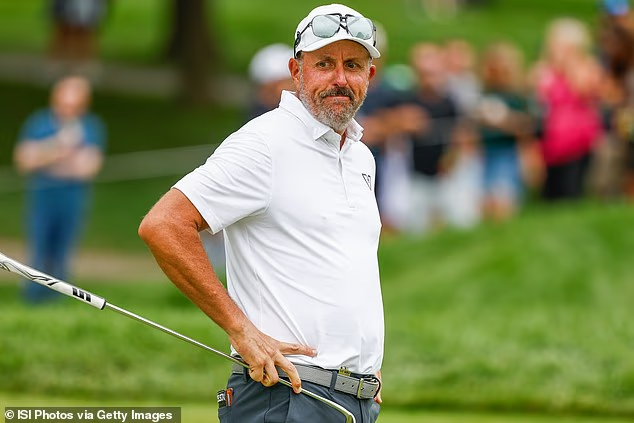

Phil’s Return and the Real Story Nobody’s Talking About
Look, after 35 years covering this tour, I’ve learned that the biggest golf stories aren’t always about what happens on the course—they’re about what happens away from it. So when Phil Mickelson finally returns to competition this week in South Africa after seven months in the wilderness, it’s worth digging deeper than the official statement.
The bare facts are simple enough:
“Phil returns to the lineup this week in South Africa!”
reads the announcement from his team. But what strikes me most is what’s not being said. A six-time major champion doesn’t vanish for nearly eight months over something routine. The fact that Mickelson felt compelled to be physically present with his wife Amy for an unspecified family health matter tells you everything you need to know about his priorities—and nothing about what actually happened.
And honestly? I respect the privacy. In my three decades around professional golf, I’ve watched enough players’ families navigate difficult times to know that discretion isn’t evasion. It’s dignity.
The Timing Question Nobody’s Asked
What fascinates me more is the when of his return. Missing four consecutive LIV events—Riyadh, Adelaide, Hong Kong, and Singapore—represents a significant chunk of the 2026 season. But then, conveniently, he’s back just in time for the final prep event before Augusta. Some might call that strategic. I call it telling.
At 55 years old, Phil isn’t playing 50 events a year like he did in his prime. He’s cherry-picking. And with the Masters coming April 9th, he’s picking the event that matters most to him. That’s not the action of someone desperately clawing back relevance—that’s the calculation of a player who still believes he has something left to prove at Augusta.
Having caddied for Tom Lehman back in the ’90s, I learned that champions think differently about major championships. They don’t lose that hunger; they just get more selective about where they spend their energy. Phil’s return timing suggests his appetite for Augusta is very much intact.
The Elephant in the Room: Last Year’s Performance
Here’s what concerns me, though. Mickelson’s 2025 major championship performance was genuinely rough. He missed the cut in three of four majors. At the Masters specifically—the place where he’s won three times—he failed to make the weekend. At Royal Portrush for The Open, he finished tied 56th. His LIV form wasn’t much better either, with his best finish in his final six events that year being tied 23rd.
That’s not a slump. That’s a structural problem.
The question isn’t whether Phil can still compete at Augusta. The question is whether seven months away, at 55, rebuilds that competitive edge or dulls it further. I’ve seen both happen. I’ve watched senior players return from injury or personal matters and play inspired golf. I’ve also watched the ring get heavier.
Context Matters: The LIV Turbulence
Phil’s absence came at perhaps the worst possible moment for LIV Golf. While he was away tending to his family, Brooks Koepka and Patrick Reed—major names—were publicly rejecting the Saudi-backed circuit. Reed even has to work his way back through the DP World Tour before returning to the PGA Tour. That’s not a tiny story. That’s a hemorrhage.
For a tour already fighting an image battle, losing established players while one of your marquee attractions goes dark for seven months? That’s a rough stretch. Phil’s return helps stop the bleeding, but it doesn’t heal the wound. His performance in South Africa and, more importantly, at Augusta will signal whether LIV’s veteran star power still has any gravity.
The Grand Slam Elephant Nobody Mentions
Here’s the thing that keeps me up at night about Phil’s career: he’s been tantalizingly close to golf’s Grand Slam for years. He’s won five major championships everywhere except the U.S. Open, where he’s finished second six times. The most recent runner-up finish was in 2013.
Rory McIlroy just completed the Grand Slam with his Masters victory last year, becoming only the sixth player ever to do it. For Phil—who’s arguably the most talented player to never win a U.S. Open—watching someone else cross that finish line has to sting.
But here’s my honest assessment: Phil’s never going to win the U.S. Open. The window closed years ago. What he can do is keep competing at Augusta, keep hunting major victories, and maybe—just maybe—add a fourth green jacket to his collection.
What I’m Really Watching For
When Phil tees off in South Africa this week, I won’t be checking the leaderboard just to see if he wins. I’ll be watching his swing tempo, his emotional management, the small tells that separate a player who’s mentally sharp from one who’s still in recovery mode. A seven-month layoff at 55 isn’t something you just shake off with a good night’s sleep.
If he plays reasonably well and carries that into Augusta, we might be looking at a genuinely interesting Masters narrative. If he struggles? It might signal that 2025’s difficulties weren’t just a bad year—they might be the beginning of a longer decline.
Either way, Phil’s return matters. Not because of the official announcement. But because of what his performances—or lack thereof—will actually tell us about whether he’s really back, or just going through the motions.
