


Rory’s Masters Menu Shows How Champions Reveal Their True Selves
I’ve been covering professional golf for 35 years, and if there’s one thing I’ve learned, it’s this: the Champions Dinner menu tells you more about a player’s character than any post-round interview ever could.
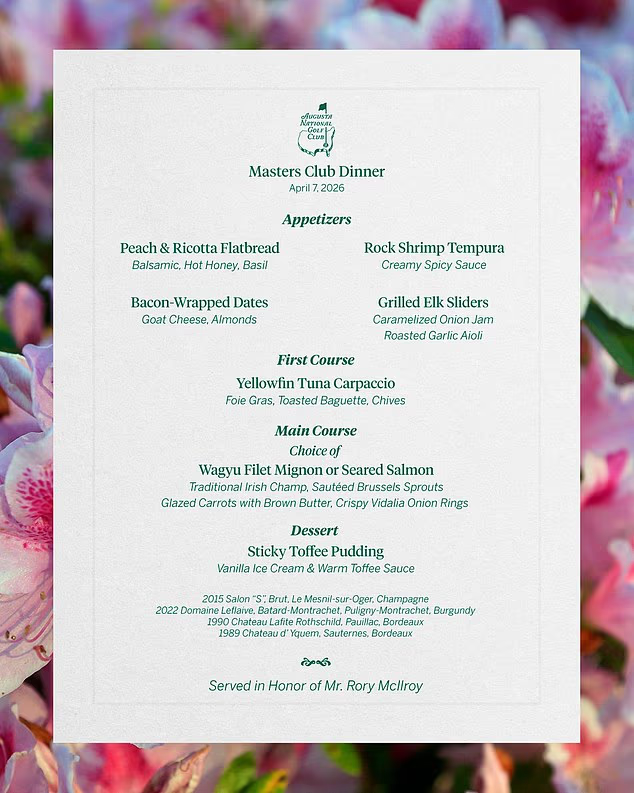
When Rory McIlroy sat down this week to unveil his 2026 Masters Champions Dinner selections, he wasn’t just picking food. He was writing autobiography on a plate.
The Personal Touches That Matter
What strikes me about McIlroy’s menu is how deliberately autobiographical it is. Here’s a guy who just completed the career Grand Slam—one of golf’s rarest achievements—and rather than go full haute cuisine flex, he’s leaning into champ. Actual Irish champ. Mashed potatoes, scallions, milk, and butter.
“When I was a kid, I used to eat champ by the bowl full,” McIlroy explained. “So I’m trying to tie in a little bit of my upbringing.”
Having caddied for Tom Lehman back in the ’90s, I saw firsthand how the pressure of major championship golf can either harden you or humble you. McIlroy’s choosing humility here, and that matters. The elk sliders—which he explained came from his pre-Masters diet last year—show someone who’s thought about this menu with genuine intention rather than just checking a box with whatever sounds fancy.
The bacon-wrapped dates “inspired by his mother’s recipe”? That’s not filler. That’s Rory saying: my mother’s wisdom is part of my victory. You don’t see that vulnerability often from the elite tier of the game.
When Augusta National Becomes a Partner
Here’s something the casual fan might miss: the Club worked directly with McIlroy to replicate the Yellowfin tuna carpaccio from Le Bernardin, the three-Michelin star restaurant in Manhattan. Let me translate what that means—Augusta National’s kitchen staff coordinated with world-class chefs in New York to get one appetizer *exactly right*.
“The club worked with me on that as well,” McIlroy revealed. “They went up to the restaurant and worked with the chefs… they wanted to get it right on the night.”
In my experience, this kind of collaboration is rare. It signals respect—not just for McIlroy the champion, but for what the Champions Dinner represents as a tradition. This isn’t some corporate obligation. This is Augusta National saying: we take this as seriously as you do.
And the wine list? McIlroy brought in his good friend Shane Lowry to help curate selections, including a 1990 Bordeaux that goes for $1,300 per bottle. Again, that’s not showing off. That’s a champion saying: I want to share something meaningful with the men who’ve walked this road before me.
The Contrast Game Tells the Real Story
Last year, Scottie Scheffler—still the world’s best player—went full Texas. We’re talking a “five-alarm fire” chili that prompted 1979 Masters winner Fuzzy Zoeller to joke about calling the fire department. Firecracker shrimp. Papa Scheff’s Meatball & Ravioli Bites. A warm chocolate chip skillet cookie.
Here’s what I think is happening: Scheffler’s menu was fun, unapologetic, and completely reflective of where he’s from. McIlroy’s is thoughtful, layered, and reflective of who he’s become. Both are legitimate approaches. Both tell a story.
Scheffler said “here’s what makes me happy.” McIlroy said “here’s where I come from, and here’s what I’ve learned.” Different philosophies, equally valid.
The Internet’s Divided Verdict (And Why It Doesn’t Matter)
As expected, social media took sides. One user posted: “These menus are always horrific.” Another countered: “Standing ovation. That’s an elite menu.”
Honestly? Both responses miss the point. The Champions Dinner isn’t designed for Twitter’s approval. It’s for the previous winners sitting at that table on April 7, 2026. It’s for Fred Ridley, the club chairman who’ll be the only other person in the room. It’s for McIlroy to feel like he’s sharing something of himself with the fraternity he’s just formally joined.
In 35 years around this game, I’ve learned that the players who handle success best aren’t the ones playing to the gallery. They’re the ones being honest about who they are.
What This Really Means
McIlroy completing the career Grand Slam last year was monumental—only five men in history have done it. But how a champion processes that achievement tells you what kind of champion they’ll be going forward. The menu he’s chosen suggests someone grounded, grateful, and willing to honor both his roots and the institutions that shaped his career.
“My favorite part of the menu is you get access to the wonderful wine cellar at Augusta National.”
That comment encapsulates it. He’s not bragging about curating an expensive wine list. He’s marveling at the privilege of accessing something that connects him to decades of tradition.
That’s the real story here. Not the elk sliders or the champ or even the $1,300 bottles. It’s a champion who understands that winning majors is just the beginning—truly honoring those wins means showing respect to the game itself.
The Masters has always been about tradition. Rory’s menu proves he gets that.
