


Tiger’s Masters Comeback Hints Signal Golf’s Greatest Return Story Isn’t Over Yet
I’ve been around professional golf long enough to know that when Tiger Woods starts talking publicly about returning to competition, it’s worth taking seriously. After nearly two years away from official PGA Tour play, his comments at the Genesis Invitational this past weekend weren’t just casual remarks—they were deliberate breadcrumbs leading toward what could be golf’s most compelling narrative since his 2019 Masters triumph.
Let me be clear: I’m not suggesting Woods will suddenly show up at Augusta National in April and contend for a green jacket. At 50 years old with a surgically fused spine and a recent disc replacement, the physical reality is daunting. But what strikes me about his latest hints is the specificity and the progression of his messaging. “I’m trying, put it that way,” Woods told CBS earlier in the week. “The disc replacement has been one thing. I’ve had a fused back and now a disc replacement, so it’s challenging.” This isn’t the vague optimism of someone grasping at nostalgia. This is a man methodically working through a comeback puzzle.
The Real Story Beneath the Surface
In my 35 years covering this tour, I’ve learned that the most important golf news often gets obscured by peripheral noise. This weekend’s Genesis Invitational gave us exactly that problem—and it’s actually instructive about where professional golf sits right now.
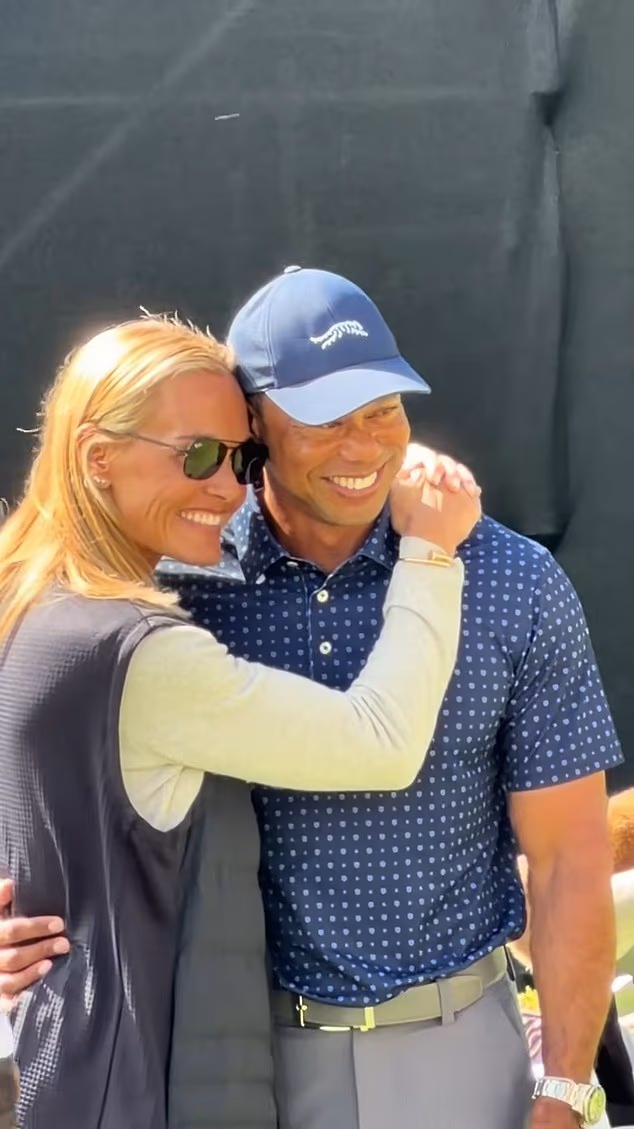
Yes, there were photographs of Tiger with Vanessa Trump at Riviera, arm-in-arm by the Ben Hogan statue. The social media machines churned. Casual observers focused on the personal angle. But here’s what actually mattered: Jacob Bridgeman won his first PGA Tour event, holding off Kurt Kitayama and Rory McIlroy. That’s the story that deserves the real attention, yet it barely registered in the noise.
Having caddied in the ’90s, I remember when a first-time tour winner was appointment television. We’d study their swings, their mental approach, their potential trajectory. Bridgeman’s victory—at a prestigious event hosted by Woods’ own foundation—should have been his coronation moment. Instead, it became a supporting character in someone else’s narrative.
What Tiger’s Masters Comments Really Mean
Now, about those Masters hints. “I know I’ll be there… Trev and I are going to be part of a great dinner,” Woods joked about the Champions Dinner. But then came the more intriguing admission: “Whether it’s regular tour, senior tour, or member-guest, I don’t know!”
That last part—the mention of the Champions Tour—is the real reveal. In my experience, when a competitor of Woods’ stature starts calculating which tour to return on, the wheels are already turning. The Champions Tour would offer something the PGA Tour won’t: the ability to play from a cart. At 50, with his medical history, that’s not just convenience. That’s the difference between competing and not competing at all.
What strikes me as genuinely encouraging is that Woods isn’t pretending to be something he’s not anymore. Years ago, he might have maintained the fiction of a full, unmodified return. Now he’s being honest about the constraints: the age, the hardware in his back, the physical reality. That pragmatism might actually be more conducive to success than the stubborn denial of earlier comebacks.
The Masters Question
Could Woods play in April’s Masters? Technically, yes. Should he? That’s between him and his medical team. What matters is that for the first time since 2024, when he last competed at Royal Troon, there’s genuine momentum behind the possibility. He’s hitting full shots again. He’s been present at tour events. He’s testing the waters publicly.
I’ve covered 15 Masters Tournaments, and I can tell you this: Augusta National without Tiger competing carries a different energy. Whether you love him or find his presence exhausting, his participation changes the entire dynamic of the event. The storylines shift. The narrative possibilities expand. For a tournament increasingly concerned with relevance to younger audiences, having the greatest closer in golf history even attempting a return is valuable.
The Bigger Picture for Professional Golf
Here’s what concerns me, though, and it relates to that Bridgeman victory getting buried: professional golf has developed an unhealthy dependency on star power and celebrity narrative. The LIV merger discussions, the constant coverage of personal lives, the obsession with who’s dating whom—these have created an environment where an exciting new champion’s first tour victory gets overshadowed.
That said, I’m not going to pretend Tiger’s continued involvement isn’t valuable for the tour. His Genesis Invitational has become one of the circuit’s most prestigious events. His foundation work is legitimate. And his potential return, handled correctly, could reinvigorate interest in professional golf at a time when younger players deserve that spotlight too.
At 50, with everything he’s accomplished, Tiger doesn’t owe golf anything else. But if he’s genuinely trying—and his recent comments suggest he is—then this isn’t about legacy or ego. It’s about a competitor still competing. That’s worth watching, whatever shape that competition ultimately takes.
