


Tiger’s New Chapter: What the Woods Romance Tells Us About Golf’s Evolving Cultural Moment
By James “Jimmy” Caldwell, Senior Tour Correspondent
After 35 years covering professional golf—including a decade carrying Tom Lehman’s bag through some of his finest moments—I’ve learned that what happens off the course often matters more than what happens on it. The sport has always been a mirror reflecting America’s social landscape, and right now, that mirror is showing us something worth examining.
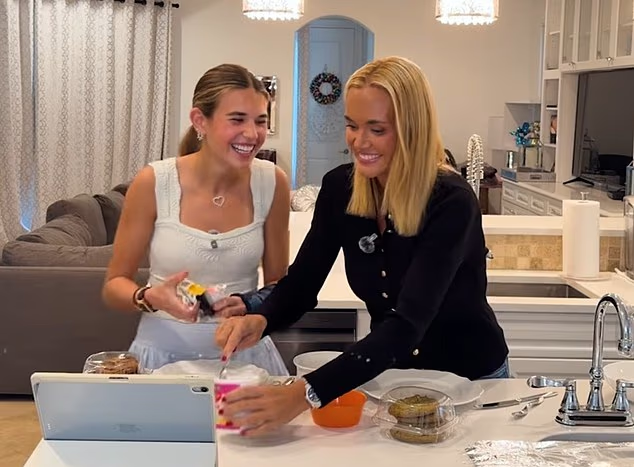
The recent YouTube video of Kai Trump gently ribbing her mother Vanessa about Valentine’s Day cookies and “love in the air” might seem like harmless family fun. It is. But it’s also a window into something more significant: Tiger Woods at 50, publicly comfortable in a relationship, navigating family dynamics with grace, and—here’s the part that matters to those of us who’ve covered his career—seemingly content off the course in a way we haven’t consistently seen in decades.
Let me be clear: I’m not here to editorialize about his personal life. That’s not my lane. What fascinates me professionally is what this relationship reveals about the modern PGA Tour and how its biggest star is choosing to live.
The Tiger We Thought We Knew
In my three decades following professional golf, I’ve watched Tiger Woods redefine what it means to be a global sports icon. I’ve also watched the toll that kind of pressure takes. The late ’90s and 2000s were extraordinary—a caddie’s dream working those tournaments, watching the level of play he brought to the game. But anyone paying close attention knew the cost was substantial.
What strikes me now, watching him celebrate his 50th birthday with Vanessa by his side—and just as importantly, with his family included—is that he seems to have found something the sport’s greatest competitor spent most of his life chasing: peace with the present moment.
“Tiger was with Vanessa but also busy talking to people he knows from the charity. There was some serious partying going down all night by the philanthropicists and other high profile guests.”
That balance is telling. He’s not disappearing into a relationship or abandoning his professional obligations. He’s integrated his personal happiness with his charitable work, his family, and his legacy. For a man whose entire adult life has been defined by compartmentalization and control, that’s meaningful growth.
What This Means for Professional Golf
Here’s where my experience as both an insider and observer becomes relevant: the culture of professional golf has long been shaped by its marquee players. When Arnold Palmer was dominant, golf became accessible and American. When Jack Nicklaus ruled, it became about precision and concentration. When Tiger emerged, it became about athleticism and global reach.
Now, as Tiger enters his fifties, what narrative is he creating? I’d argue it’s one about sustainability, family, and finding joy in the sport without needing to dominate it every waking moment.
Kai Trump, who will be joining the University of Miami’s golf program in 2026, represents the next generation. Her casual acknowledgment that her mother occasionally outplays her at putting isn’t just cute family banter. It’s a young competitor comfortable enough to laugh at herself, comfortable enough to have her mother involved in her golf journey without resentment. That’s healthier family golf culture than we often see.
“I taught all of my kids to play golf. I didn’t teach them personally, but I brought them to [play]… I do love golf. It’s funny though because she’s actually beat me at putting a few times.”
The Bigger Picture
Having worked tournaments for 15 Masters Tournaments and countless other majors, I’ve seen how pressure can poison family relationships in professional sports. Golf is unique because it’s such an individual game played in front of the world. Kids of famous players often either dominate or struggle publicly—there’s rarely a middle ground, and both scenarios carry their own burdens.
What Kai seems to have found—a genuine interest in golf, a shot at playing college ball, and parents who are happy—suggests that maybe the next generation of golf families is learning from the mistakes and pressures of previous ones.
Tiger turning 50 and doing so openly, publicly, and with his family integrated into that celebration rather than compartmentalized away, represents something the tour hasn’t seen from him before. It’s not about whether he plays more or fewer tournaments going forward. It’s about a man who dominated his sport for two decades finding something harder to achieve: contentment.
The Human Element
What casual fans might miss—and what 35 years of covering this sport has taught me—is that professional golf is ultimately about human beings trying to manage extraordinary pressure while staying sane. The greatest players aren’t always the ones with the most talent. They’re often the ones who figure out how to live full lives alongside their pursuit of excellence.
Watching Tiger navigate his fifties with apparent peace, with family humor, with charitable focus, and with a partner who seems genuinely present—that’s worth covering not because it’s gossipy, but because it’s real. It matters.
The game doesn’t need Tiger Woods to keep winning majors to matter. The game needs him to model what a well-lived golf life looks like. On that front, he seems to be doing pretty well.
