

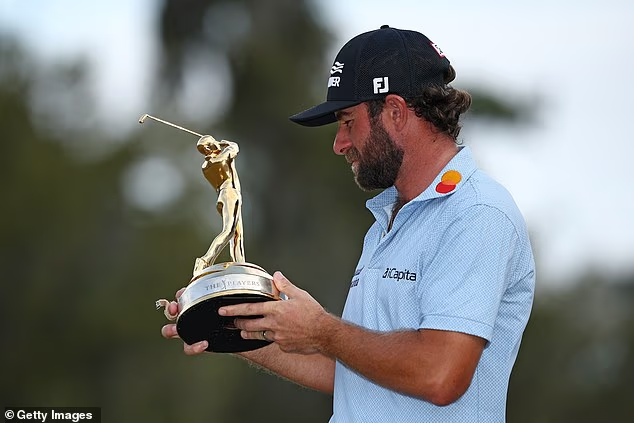

Cameron Young’s Players Victory Signals the Arrival of a Tour Star—and a Reckoning for Golf’s New Guard
I’ve been covering professional golf for 35 years, and I’ve learned to recognize the difference between a good win and a transformational one. Cameron Young’s victory at The Players Championship on Sunday wasn’t just another PGA Tour title—it was the moment a talented player became a genuine force in the game.
What strikes me most about this win isn’t the $4.5 million paycheck or even the jump to No. 4 in the world rankings. It’s the manner in which Young seized control when the moment demanded it most. In my experience caddying for Tom Lehman back in the day, I learned that major championships—and The Players is golf’s loosest definition of one—reveal character under pressure. Young didn’t just survive Sunday’s brutal back-nine conditions at TPC Sawgrass. He thrived.
The Shot That Changed Everything
Let’s talk about what actually happened out there. Young entered the final round trailing Ludvig Aberg by three shots. On paper, that’s manageable. On the Island Course with the wind howling and the pressure mounting, it’s a mountain. But Young played bogey-free golf on the back nine—a feat that seemed almost impossible given how many contenders imploded.
The decisive moment came on the 17th, that wickedly difficult par-3 that has humbled better players than most of us will ever see. With wind gusting at their backs and the island green shrinking by the second, Young and Fitzpatrick stared across the water. Fitzpatrick found the middle of the green, 30 feet away. Young’s tee shot caught the ridge and rolled to 10 feet.
“The nerves kicked in over the 8-inch putt on the last. That hole looked really, really small there from pretty close range.”
Young would eventually need that par. But before we get there, we need to talk about what happened to Ludvig Aberg.
The Collapse That Nobody Saw Coming
Aberg’s implosion on the back nine was genuinely shocking. A three-shot lead going into Sunday is hardly insurmountable—I’ve seen them blown before—but Aberg didn’t simply lose his way. He unraveled in ways that suggested the weight of the moment got to him in a hurry.
On the 11th, a par-5 where he should have been attacking, Aberg flared his approach into the water. Bogey. The next hole, he pulled his tee shot badly into the water, pitched over the green, and carded double bogey. Just like that, a three-shot lead evaporated into a three-shot deficit.
“I would have loved to be standing where Cameron is standing right now. It definitely stings a little bit.”
What I find intriguing about Aberg’s collapse is what it tells us about the current generation of elite young players. These guys have grown up competing in a world of technology, analytics, and constant connectivity. They’re brilliant with a golf club. But championship temperament—the ability to compartmentalize and execute when everything feels like it’s slipping away—that’s still a skill that takes reps and scars to develop. Aberg will be back in contention plenty of times. This loss won’t define his career. But it matters.
Fitzpatrick’s Bitter Pill
Matt Fitzpatrick played well enough to win. Let’s be clear about that. He made two consecutive birdies on the 12th and 13th, stayed in the fight when others faded, and gave himself a real chance. But on the 18th, after hitting what he felt was a good drive, Fitzpatrick’s approach drifted too far right into the pine straw.
“I felt like I hit a good drive. And once you’re out of position it’s difficult to make your par.”
That’s professional grace under disappointment. Fitzpatrick pitched out short of the green, chipped to 8 feet, and missed the putt that would have forced a playoff. Second place at The Players is nothing to dismiss, but for a player of Fitzpatrick’s caliber, it’s a missed opportunity that will linger.
The Ryder Cup Factor
Here’s what most observers might miss: Young’s Ryder Cup experience at Bethpage Black last September played a tangible role in his demeanor down the stretch on Sunday. Young was the best American player that week, winning his leadoff match during a furious U.S. rally that ultimately fell short. But the experience—playing in front of screaming crowds, executing under nationalism’s weight, competing against the world’s best when it matters most—that stays with you.
Young himself acknowledged drawing from that well. When Fitzpatrick suggested the crowd noise at The Players was child’s play compared to Bethpage, he had a point. But for Young, that experience was inoculation. He’d already played under pressure that would break lesser competitors.
Looking Forward: A Star Emerges
Before this week, Young had only one PGA Tour victory—last summer at the Wyndham Championship. He’d been a bridesmaid seven times on the PGA Tour, tying the modern tour record for runner-up finishes without a win. That’s the kind of statistical anomaly that breeds self-doubt.
Now, at 28 years old, Young has the signature victory every elite player needs. He’s moved into the top five in the world. He enters The Masters—that supreme test of skill and composure—in championship form.
In three decades covering this game, I’ve learned that the tour is cyclical. Young, Aberg, Schauffele, MacIntyre—this is the new guard. They’re talented, they’re hungry, and they’re learning what it takes to close out major championships. Some will thrive. Others will fade. But on Sunday at Sawgrass, we watched one of them take a definitive step forward.
That’s worth paying attention to.
