


Tiger’s Return and the Messy Reality of Golf in 2026
Let me be straight with you: the Genesis Invitational this past weekend gave us two very different stories, and they couldn’t be more emblematic of where professional golf sits right now.
On one hand, we had Jacob Bridgeman winning his first PGA Tour event—holding off Kurt Kitayama and Rory McIlroy, no less. That’s the kind of moment that reminds you why we love this game. A young player finally breaking through at one of the tour’s marquee events. That matters. That’s the story about competitive golf that should dominate the conversation.
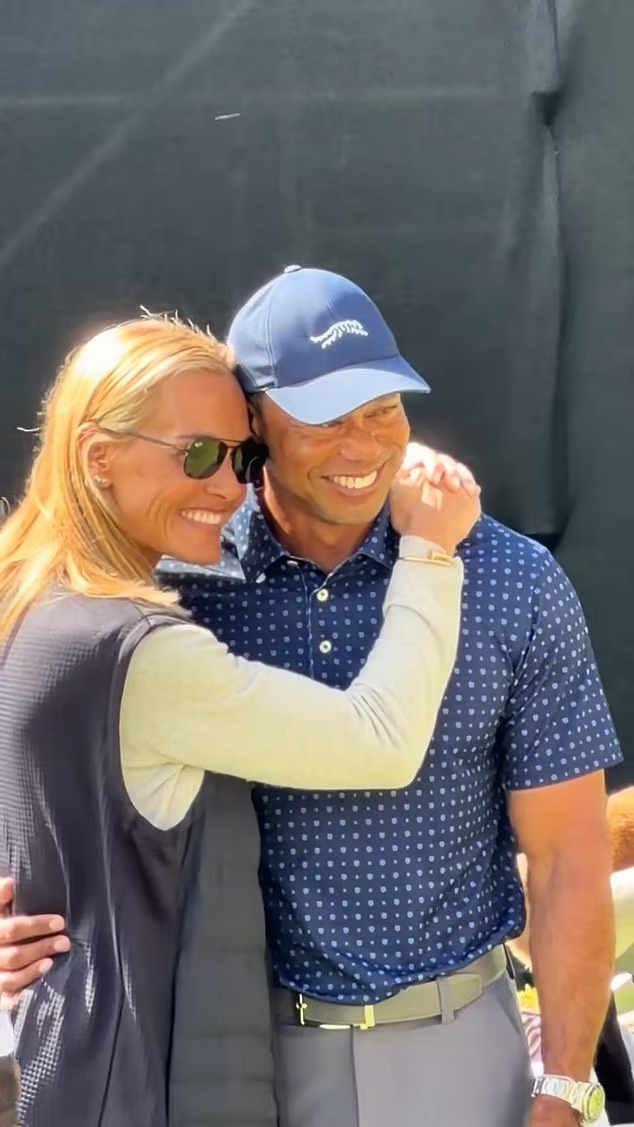
But of course, what dominated the conversation was Tiger Woods and Vanessa Trump’s public display of affection captured on TikTok at Riviera. And here’s where I need to be honest about what I’ve learned in 35 years covering this tour: the sport has fundamentally changed in how it intersects with celebrity, politics, and personal life.
When Personal Life Becomes the Headline
In my experience covering Tom Lehman through the ’90s and 2000s, player relationships were background noise. You knew who was dating whom, who was divorcing, but it wasn’t the lead story at a tournament. The *golf* was the lead. I’ve watched that calculus flip almost entirely—and while I’m not here to moralize about it, I think it’s worth examining what it means for the sport.
The fact that Woods is even *at* Riviera, presentable and appearing publicly in a relationship, is itself noteworthy. The man’s had two back surgeries, played his last official event nearly two years ago at Royal Troon, and is now 50 years old. By any reasonable standard, his competitive playing career should be in its absolute twilight. Yet here he is, still front-page news, still driving narrative.
“I don’t feel 50 – I feel a hell of a lot older,” Woods joked to CBS.
That’s darkly funny, and it tells you something important: Tiger knows what his body is telling him. He’s not under any illusions about his physical capabilities at this stage. And yet, the man is still hinting at Masters appearances, still generating headlines, still relevant in a way almost no other 50-year-old golfer in history has managed.
The Masters Question Lingers
Here’s what strikes me about Woods’ carefully measured comments this week: he’s leaving the door open, but he’s not committing. Smart. Having caddied in the ’90s, I learned that Tiger’s greatest asset has always been managing expectations—both his own and the public’s. His comments about possibly returning for the Masters in April, or playing on the Champions Tour in a cart, show a man who understands the difference between possibility and probability.
“I’m trying, put it that way. The disc replacement has been one thing. I’ve had a fused back and now a disc replacement, so it’s challenging. And now I entered a new decade, so that number is starting to sink in and has us thinking about the opportunity to be able to play in a cart.”
What I find genuinely interesting here is his willingness to explore the Champions Tour. That’s not something the old Tiger would’ve entertained. But the man is 50 now, and he’s smart enough to understand that his legacy isn’t dependent on whether he wins again on the PGA Tour. It’s already written. What remains is how he chooses to spend the years he has left in the game.
The Real Story at Riviera
Let’s circle back to what actually happened on the course: Bridgeman’s win is precisely the kind of outcome that should excite tour observers. In my experience, these breakthrough moments are crucial for the tour’s health. You need young players proving they can win against the best fields. You need new names in the mix. Bridgeman held off McIlroy down the stretch at one of golf’s most prestigious events—that’s a significant accomplishment that deserves more ink than it’s probably getting.
The Genesis Invitational, sponsored by Woods’ foundation, remains one of the tour’s strongest events. The venue is beautiful, the field is elite, and the tournament has genuine prestige. That’s partly because Tiger built it that way, and partly because Riviera itself carries historical weight dating back generations.
What It All Means
In my three decades covering professional golf, I’ve never seen the line between personal celebrity and athletic achievement blur quite like it has in recent years. Some of that is inevitable—we live in an age of social media and constant documentation. Some of it reflects genuine changes in how we consume sports entertainment.
What I think matters most, though, is that the golf itself remains excellent. The players are better than ever. The competition is fierce. And when young players like Bridgeman break through, or when aging legends like Woods show they’re still fighting, *that’s* what keeps the sport vital.
Tiger’s personal life is his own business. But his presence at events, his willingness to remain connected to the game, and his hints at potential return appearances all suggest he’s not quite ready to fade away entirely. Whether he plays the Masters in April or not, whether he eventually competes on the Champions Tour or not—these are questions for another day.
For now, we have a young champion at Riviera and a 50-year-old icon who refuses to go quietly. Both are good for golf.
