


The Masters Standoff: What the McIlroy-DeChambeau Clash Really Reveals About Modern Golf
I’ve spent 35 years around this game—caddied for Tom Lehman, covered fifteen Masters, watched the tour evolve from transistor radios to TikTok. And I can tell you with certainty: the moment Rory McIlroy stood his ground against Bryson DeChambeau on the ninth green last April wasn’t just about a putt. It was a glimpse into something much deeper about the current state of professional golf.
Now that Rory’s Amazon Prime documentary is about to premiere, and we’re finally getting the full story of what really happened during that final round, it’s worth taking a step back and understanding what this clash actually means—not just for these two talented players, but for the sport itself.
The Moment Everyone Missed
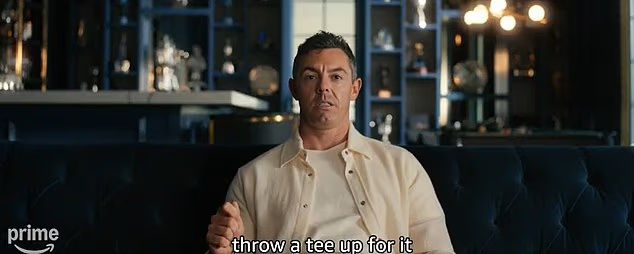
Here’s what went down, according to McIlroy’s new documentary account. Both players had birdie opportunities on the ninth hole during Sunday’s final round. They stood over their putts, neither moving. DeChambeau suggested they “throw a tee up for it”—essentially flip a coin—to decide the order of play.
“And I’m like ‘no, this is the final round of the Masters, this isn’t some game on a Tuesday afternoon somewhere,'” McIlroy recounted in the film.
What strikes me about this exchange isn’t the disagreement itself. In my experience, competitive disagreements happen constantly on professional golf courses. What’s notable is how each player chose to handle it. DeChambeau’s suggestion to literally randomize the decision feels very 2026-era golf to me—casual, almost performative in its nonchalance. McIlroy’s response—asking for an official to measure—represents something more traditional, more reverent toward the rules and the majesty of the moment.
McIlroy ultimately went first, made his putt for a birdie to reach 13-under, and DeChambeau missed for par. That putt—and McIlroy’s composure in that moment—likely made the difference in a tournament Rory won in a playoff against Justin Rose to complete the Grand Slam.
The Gamesmanship Behind the Stand
Here’s something most casual fans don’t understand about professional golf at this level: the psychological warfare on the green is real and sophisticated. McIlroy himself acknowledged this in the documentary:
“It was a very gamesmanship-y matchplay thing. Really, both of us want to putt first, because if you can hole your putt before your opponent has his turn, it puts pressure on them.”
In my three decades covering the tour, I’ve seen this dynamic play out countless times. The player who putts first owns the green. They control the narrative. If they make it, their opponent feels the heat. If they miss, the pressure compounds. DeChambeau understood this perfectly well—which is precisely why he was pushing back on the order in the first place.
What I found admirable about McIlroy’s response wasn’t aggressive or petulant. It was simply… firm. He didn’t wilt. He held his ground without escalating. That’s the mark of a champion’s temperament.
The Bigger Picture: Tour Politics and LIV’s Shadow
Now here’s where this gets interesting from a broader tour perspective. DeChambeau, as a LIV Golf star, has been operating in a different ecosystem than McIlroy. LIV events, while containing top talent, carry a different vibe—shorter tournaments, different pacing, less traditional pageantry. When DeChambeau suggested “throwing a tee up,” was that just casual banter, or a philosophical clash between two different visions of professional golf?
I think it’s both. And what fascinates me is what happened after the round.
DeChambeau claimed McIlroy hadn’t spoken to him all day:
“No idea. [McIlroy] Didn’t talk to me once all day. He wouldn’t talk to me.”
McIlroy’s response was refreshingly blunt: “I was not there to be his best friend. We were trying to win the Masters.”
In my years caddying and covering the tour, I’ve learned that this kind of competitive coldness isn’t disrespectful—it’s professional. The Masters isn’t a social outing. It’s arguably the most pressure-laden 72 holes in golf. McIlroy understood that perfectly.
Context from Vegas: The Deeper Rivalry
The documentary’s timing reveals something revealing about the undercurrent between these two. Back in December 2024, during “The Showdown” event in Las Vegas (a PGA vs. LIV exhibition), McIlroy was mic’d up and said he’d like to face DeChambeau on the final day of a major to “try to get him back for what he did to me at the US Open.”
DeChambeau’s response? A pointed reference to McIlroy’s 2024 US Open collapse at Pinehurst, where Rory missed crucial putts down the stretch while DeChambeau holed a dramatic bunker shot to win. Cold. Professional. But also deeply competitive in a way that transcends tour politics.
This is the part of professional golf that casual fans sometimes miss: these rivalries aren’t manufactured. They’re rooted in real moments where one player’s failure became another’s triumph.
What This Moment Really Means
The Masters standoff, now that we’re seeing it through McIlroy’s perspective, represents something healthier than it might initially appear. Yes, there’s friction between these players. Yes, tour factions matter. But what we’re really witnessing is two elite athletes competing fiercely for one of sport’s greatest prizes.
In 35 years covering this game, I’ve learned that the best championships are built on moments like this—when players stand firm in their convictions, when they refuse to be intimidated, when they execute under pressure. McIlroy did all three on the ninth green.
The documentary premiering March 30 on Prime Video will likely stoke the fire between these two players. And honestly? Golf is better for it. This sport thrives on genuine rivalries, on moments where we see not just technical excellence but mental fortitude.
That’s what the ninth green last April really was.
Rory McIlroy: The Masters Wait premieres March 30 on Prime Video.
Sports on Prime @SportsonPrime
