


As a golf architecture enthusiast who’s had the privilege of traversing over 200 courses across the globe, I’ve developed a profound appreciation for the subtle brilliance and daring ingenuity that define truly great design. From the minimalist masterpieces of Tom Doak to the audacious earthworks of Pete Dye, I understand that a golf course isn’t just a collection of holes; it’s a meticulously crafted experience, a strategic puzzle, and often, a living work of art.
My latest stop on this endlessly fascinating journey takes me to Memorial Park in Houston, a municipal gem that recently underwent a transformation, emerging with a refined character that’s turning heads, particularly among the PGA Tour elite. This isn’t just any muni; it’s a testament to thoughtful renovation, a place where strategic nuances meet public accessibility.
The Vision: A Public Park with Championship Teeth
Memorial Park has a fascinating story, a public-access course with a significant history. The recent renovation, however, truly vaulted it into the architectural spotlight. The philosophy behind the redesign appears to be a careful balance: challenging enough for the world’s best, yet enjoyable and playable for the everyday hacker. And who better to consult on such a venture than a multiple major champion known for his strategic prowess? Brooks Koepka, a consultant on the project, offered some fascinating insights into the design philosophy, particularly regarding the areas around the greens.
“We talked about bunkers quite a lot,” Koepka said. “I felt the one thing where if I get a good lie in a bunker, I can pretty much get it up and down, looking to hole it.”
This reveals a foundational understanding of modern professional golf. Bunkers, for the pros, are often less punitive than they are for amateurs. The renovation at Memorial Park seems to have embraced this reality by minimizing traditional sand traps in favor of expansive, undulating run-off areas around the greens. This isn’t just a cosmetic choice; it’s a strategic gambit that fundamentally alters the recovery shot dynamics.
As a devotee of design, I find this approach incredibly compelling. It echoes the principles of architects like Alister MacKenzie, who believed in creating challenges through natural contours rather than manufactured hazards. The emphasis on “a lot of fairway, a lot of undulation around” the greens, as Koepka described, means players are faced not with a simple sand shot but with a myriad of options – putter, wedge, even a bump-and-run with a mid-iron. This complexity, paradoxically, can be more daunting for the pros.
“But I think sometimes when pros get too many options, it becomes a little bit more difficult than just, oh, there’s one option, take a 60 and kind of spin it. It makes it a little bit tougher because you never know which one’s quite the right play.”
This is where the genius of the redesign truly shines. For the amateur, these expansive run-offs offer a chance to putt from off the green, fostering a more enjoyable and less penal experience. For the pro, it introduces doubt and demands a nuanced understanding of lie, slope, and club selection, often leading to more dramatic recovery attempts and outcomes.
The Test: A Case Study in Green Complex Nuance
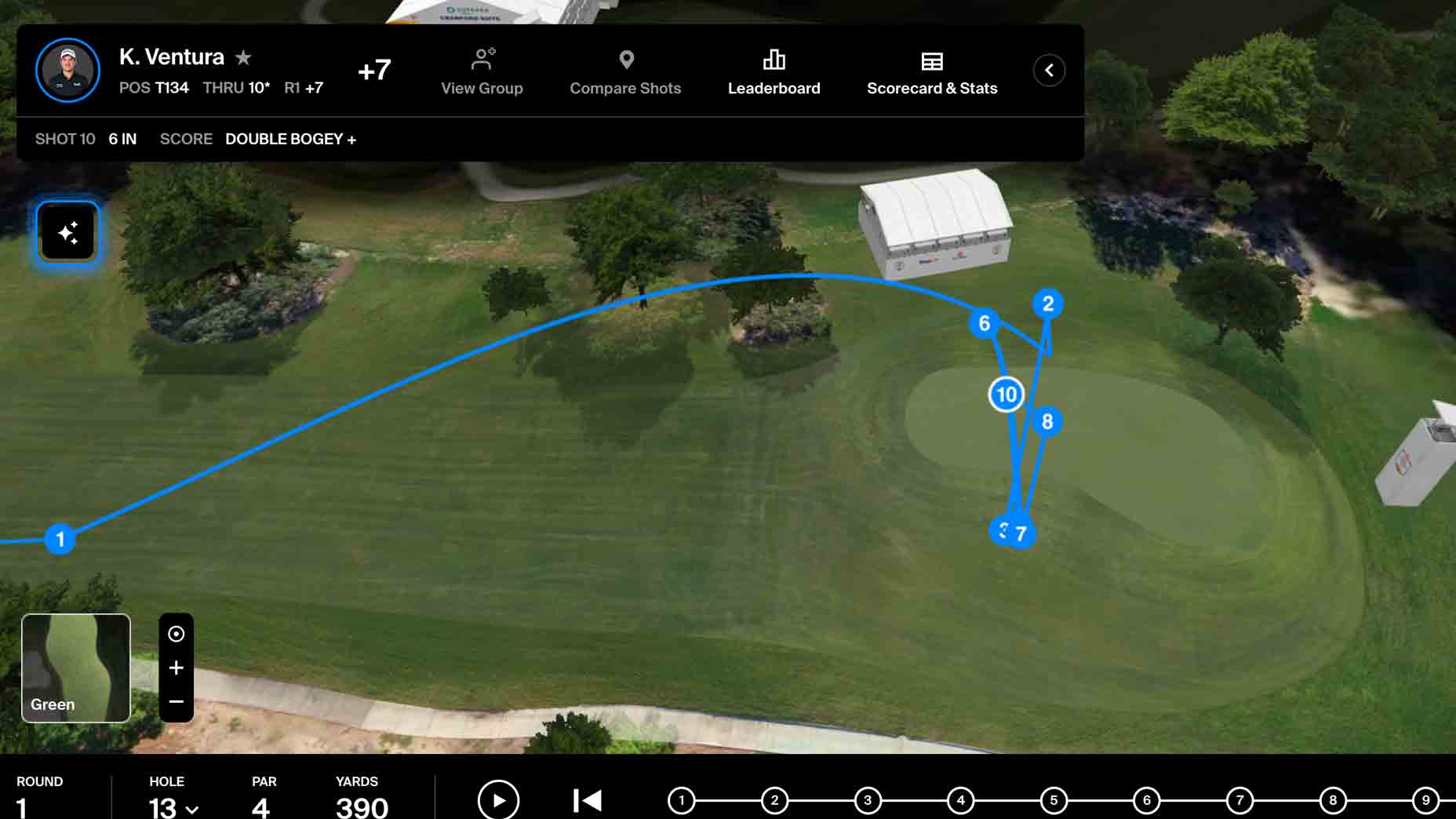
This design philosophy was put to a rather brutal test during the recent Texas Children’s Houston Open, particularly on the 13th hole. Kris Ventura, a 31-year-old pro from Norway with a respectable $3 million in career earnings, provided a vivid illustration of the challenges these unique green surrounds present. On the 390-yard par-4 13th, Ventura found himself just to the left of the green, 59 feet from the hole after his second shot. What followed was a remarkable sequence of events that highlights the strategic depth of Memorial Park’s design.
Ventura’s journey from just off the green to a sextuple-bogey 10, a truly rare sight for a professional, was a masterclass in how subtle undulations and strategic green shaping can wreak havoc. His third shot went across the green to the right. His fourth and fifth stayed on the right side. His sixth went across to the left. His seventh, back across to the right. It wasn’t until his eighth shot that he finally found the putting surface.

pgatour.com
This graphic perfectly illustrates the kind of torture this type of green design can inflict. Ventura’s experience wasn’t a fluke; it was a demonstration of how a severe slope or a subtle kick can send a ball ricocheting away from the desired target, demanding precision and a touch that even seasoned pros can struggle to find under pressure. This, in my opinion, is brilliant architecture. It creates drama, punishes inaccuracy without being unfair, and elevates the short game to an art form.
“And then when you take that and look at — because this place isn’t just for this week, this place, it’s for the 51 other weeks a year, right? There’s so many people that come out here and can play golf. And for amateurs, I feel like it’s — the bunker isn’t a place for them to be greenside. They’re not great out of bunkers, most of them.”
This astute observation from Koepka truly captures a core tenet of enduring municipal golf design. Memorial Park isn’t a one-week wonder; it’s a course designed for the community. The absence of deep, intimidating bunkers, replaced by contours from which an amateur can confidently putt, speaks volumes. It makes the course approachable for everyday players while simultaneously presenting a nuanced, thought-provoking challenge for the world’s best. It’s a design that respects both demographics, a rare and commendable achievement.
Playing Memorial Park: What to Know
Memorial Park is located in the heart of Houston, Texas, easily accessible for anyone visiting the city. As a municipal course, it embodies the spirit of public golf, offering a high-quality experience without the exclusivity often associated with championship venues. While it hosts the PGA Tour, its municipal status means it’s generally open to public play, though booking tee times well in advance, especially after its recent television exposure, is highly recommended.
When you play Memorial Park, expect a course that values strategic thinking over brute force. The fairways are generally generous, inviting you to swing away, but the approach shots are where the real test begins. Pay close attention to pin positions and the subtle breaks around the greens. Don’t be afraid to pull out the putter from well off the green – it’s often the smartest play. The course flows naturally through its parkland setting, offering a serene escape amidst the bustling city. The routing feels seamless, guiding you through a varied landscape that capitalizes on existing terrain rather than forcing artificial features.
In essence, Memorial Park isn’t just a renovated golf course; it’s a masterclass in how to modernize a classic while respecting its public roots. It’s a course that rewards intelligence, punishes arrogance, and offers a truly engaging experience for every golfer, from the weekend warrior to the major champion. I, for one, can’t wait to see more courses embrace this thoughtful, strategically rich, and elegantly understated approach to golf architecture.
