


Gary Woodland’s Courage Reminds Us What Real Strength Looks Like on Tour
I’ve been around professional golf long enough to know that vulnerability isn’t typically part of the tour playbook. In my 35 years covering this game—and especially during my time as Tom Lehman’s caddie—I watched players compartmentalize everything. You had your game face. You had your public persona. And you absolutely, positively did not let the world see you struggle.
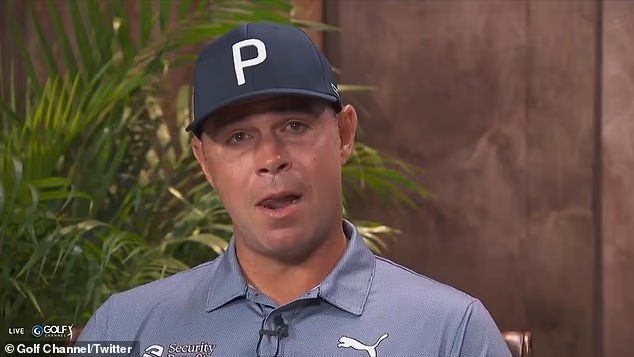
Which is why Gary Woodland’s decision to go public about his post-traumatic stress disorder three days before the Players Championship hits differently. This wasn’t some retirement-party retrospective. This was a guy saying, “I’m still here, still fighting, and I’m done pretending everything’s fine” while literally preparing to compete in one of golf’s most demanding tournaments.
When Medical Victory Becomes Psychological Battlefield
Here’s what strikes me most about Woodland’s situation: the brain surgery itself was a success. The titanium plate is in place. The tumor is gone. By every clinical measure, the doctors won. But as Woodland explained in that emotional Golf Channel interview, removing a tumor isn’t the same as removing trauma.
What happened to Woodland is instructive for anyone who thinks professional athletes are somehow immune to mental health struggles. The tumor had grown on his amygdala—literally the part of the brain that processes fear and anxiety. For years, he was living with a biological amplifier on his panic response. Then, after surgery, that physical problem was solved. But the psychological scars remained.
“I can’t waste energy anymore hiding this. I was hyper-vigilant. A walking scorer startled me, got close to me from behind. I pulled my caddie and said, ‘You can’t let anybody get behind me.’ Next thing I know, I couldn’t remember what I was doing.”
That moment—a simple mistake by a scorer, and suddenly Woodland couldn’t hit his shot—isn’t weakness. It’s neuroscience. PTSD is real, and it doesn’t care about your US Open trophy from 2019.
The Tour’s Response: Actually Getting It Right
In my experience, tour policy has historically lagged behind player welfare issues. We’ve seen slow progress on everything from mental health resources to pace-of-play standards. So I was genuinely impressed to learn that the PGA Tour has been proactive here, working with Woodland to implement security protocols that give him actual control over his environment during competition.
This matters. It’s not charity or pity—it’s recognition that when a player is dealing with legitimate trauma, small environmental adjustments can be the difference between competing and completely falling apart on the course. The tour didn’t have to do this. But they did.
The Cost of Hiding
What Woodland described about his daily reality is heartbreaking, particularly the impact on his family. Here’s a guy who has to leave rooms when his own children get excited because his brain can’t handle the stimulation. His wife essentially became a full-time monitor. His kids didn’t understand why dad had to go lay in a dark room.
And yet, despite his doctors’ recommendation to avoid high-stress environments, Woodland refuses to step away. That’s not foolish. That’s actually the right call, and here’s why: golf is his dream. His identity. Stepping away might feel safer in the short term, but it would cost him something fundamental.
“In an ideal world I’m probably not playing. But in an ideal world I don’t have this. This [playing golf] is my dream.”
This is the tension that makes Woodland’s situation so compelling. He’s not denying reality. He’s acknowledging it and choosing to live his life anyway, armed with better tools and honest communication about what he needs.
What This Means for Professional Golf Culture
Having spent 15 Masters Championships on the grounds and covered countless tour events, I’ve seen the culture shift incrementally toward mental health awareness. But there’s still a pervasive idea that toughness means silence. That you handle your problems privately and show up ready to compete.
Woodland is challenging that directly. By speaking publicly about his PTSD—not in some sanitized, corporate wellness announcement, but in an emotional, real conversation just days before a major tournament—he’s saying something radical: “I can be mentally struggling AND still be out here competing AND still deserve respect.”
“I hope somebody that’s struggling sees me out here still fighting and battling and trying to live my dreams. You can’t do this on your own, no matter how strong you think you are.”
That last part is key. The old tour mentality was that you absolutely could and should do it alone. Woodland is explicitly rejecting that. And younger players are paying attention.
The Broader Picture
Gary Woodland isn’t going to win the Players Championship this week just because he’s being brave about his mental health. That’s not how golf works. But what he’s doing—continuing to compete at a professional level while publicly managing a serious mental health condition—sets a precedent. It normalizes the conversation. It tells other athletes that you don’t have to choose between your health and your career.
That’s worth more than a trophy. Not instead of a trophy—alongside whatever he achieves on the course—but as its own achievement.
After 35 years in this business, I can tell you: real strength has never looked like perfection. It looks like Gary Woodland, still showing up, still fighting, and finally willing to let the rest of us know what the fight actually costs.
